
Most businesses today feel constant pressure to release digital products faster without compromising on quality. Customer expectations are rising, product cycles are shrinking, and competition is becoming intense across almost every industry. A report by Deloitte states that companies using Agile development practices can improve time-to-market by up to 60 percent, which shows how crucial a fast yet controlled approach has become for product success. Many companies are also re-evaluating the mobile app development tools they use, as well as how offshore app development cost affects delivery speed.
This blog will explore how Go-To-Market strategy planning is evolving, what slows product launches in traditional workflows, and how Agile Mobile App Development helps shorten release cycles. We will also look at how Agile methodology improves collaboration between go-to-market teams, why it matters for businesses building custom mobile app development solutions, and how the right development partner can streamline the entire mobile app development process.
What Slows Down Your Go-To-Market Timeline Today?
Many businesses have a defined GTM strategy, but still struggle to launch their products on schedule. Here are some of the reasons that can slow down your go-to-market timeline
-
Rigid Development Processes Slow Down Every Stage
Linear development strategies still practiced in several companies dictate that a phase needs to be finished before the next stage can begin. If a problem arises in that phase, the whole project is at a standstill because no one can move to the next phase until the problem has been cleared. This is a major bottleneck in the decision-making process. Additionally, inhibits teams from agile responses in the face of changing customer requirements and market conditions.
-
Siloed Teams Create Gaps in Communication
Business, sales, engineering, and product marketing teams within an organization often work in silos. Additionally, each with its own focus and timelines. Without real-time collaboration, there’s a cascading effect that regresses due dates, slows down communication, and leaves go-to-market teams with insufficient detail to be able to plan a launch. This misalignment is the main culprit that leads to delays in the launch.
-
Limited Technology and Outdated Tools Stretch Timelines
A poor cycle of app development is a reflection of poor development tools and digital product development practices of a company. These poorly coordinated offshore development projects become even more difficult to manage. Planning costs with multiple vendors makes this issue more complicated. Ultimately, these gaps create unnecessary friction that disrupts the entire workflow.
-
Slow Iteration Reduces Responsiveness To Market Changes
Traditional development models make it difficult to act on new insights, customer feedback, or competitive moves. Since changes come only at later stages, teams lose valuable time and miss early opportunities to refine the product.
What Is Agile Mobile App Development?
Agile Mobile App Development is an approach where work happens in small, iterative cycles rather than a long, linear sequence. In contrast, working for months on a single product, the team works on a(sola) version of the product where they can incrementally add features and functionality. Further, getting the riskiest and most important features first, to gain developmental feedback from users as they work. Each of these cycles, dubbed sprints, goes through the same sequence of planning, designing, developing, and optimizing. This ensures a user is included in every part of the development. This approach is particularly good for developing natively built mobile software because there are many components, like UI design, various integrations, and customer experience improvement, that can act independently and in parallel as a team learns more about user behavior.
Agile’s methodologies support business changes that may happen at a moment’s notice. This is a particularly desired characteristic when companies need to adapt quickly with the software, and it is a significant factor that helps keep the development ecosystem intact.
Overall, Agile offers a structure that can adapt to the changes of the market, while also helping to provide quality, assurances, and complete transparency along the development process.
How Agile Mobile App Development Accelerates Your Go-To-Market Strategy?
A strong Go-To-Market strategy requires fast execution, consistent updates, and quick feedback cycles. Agile methodology aligns naturally with these needs, making it easier for businesses to launch products on time and with fewer risks.
-
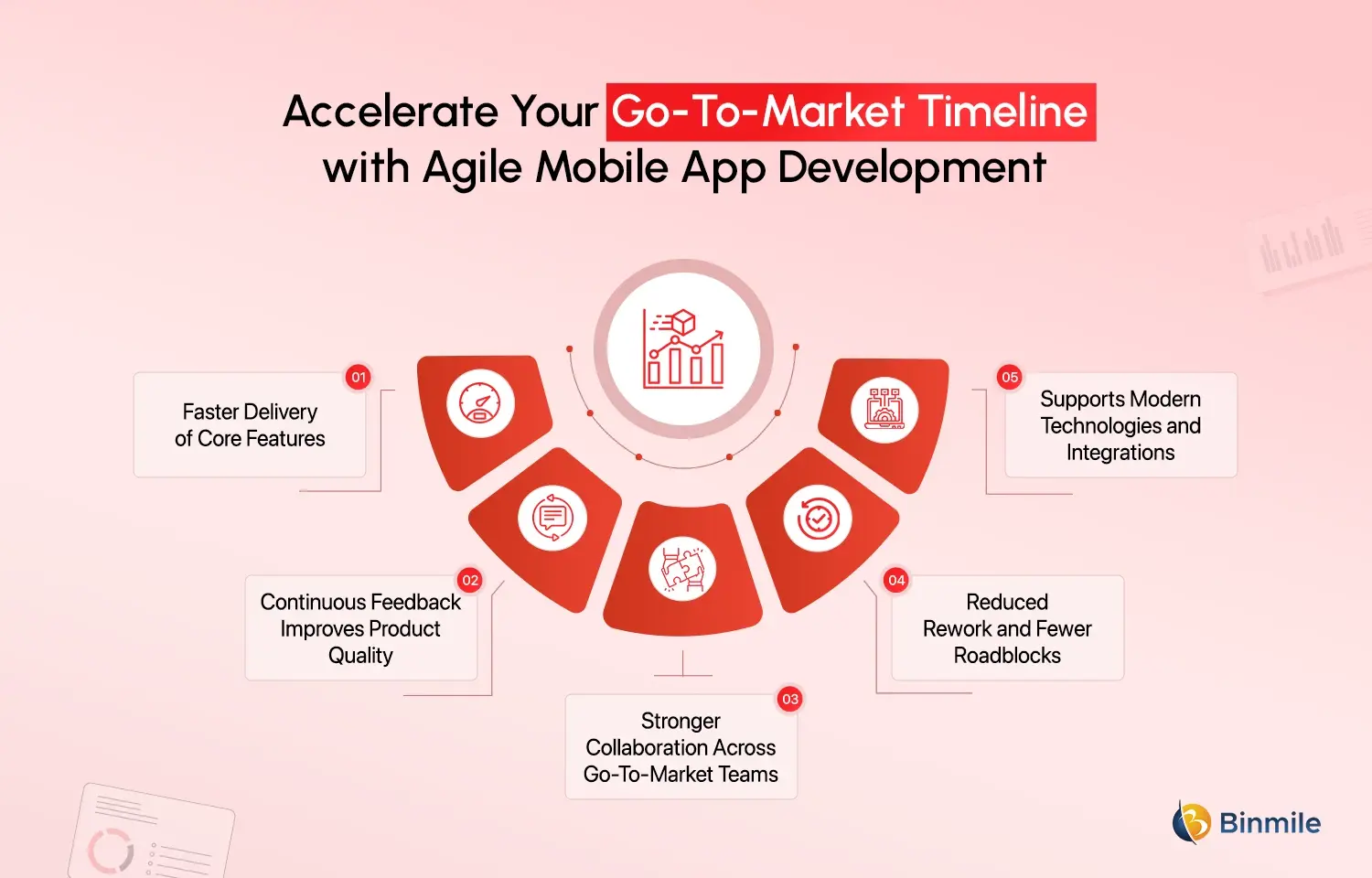
Faster Delivery of Core Features
In Agile methodology, the focus is placed on the essential features first, rather than waiting for the entire product to be finished. Delivering this value early allows the companies to validate the concept in actual market conditions, receive feedback, and refine the concept while the design is in motion. Agile mitigates time on assumptions as the product is built on user feedback.
-
Continuous Feedback Improves Product Quality
In Agile, each development is followed by testing, reviewing, and gathering feedback. This approach leads to refilling the list of issues and fixing them immediately rather than accumulating. Since the team continues to improve the product, the final launch is far smoother, resulting in far fewer of the last-minute obstacles that could push the launch date out.
-
Stronger Collaboration Across Go-To-Market Teams
Agile development methodology encourages collaboration between product, engineering, design, QA, and go-to-market teams. This is done through regular updates and visible project tracking. Everyone is on the same page with the schedule, goals, and what they are all working on. This closes the communication gaps that can slow down the marketing and preparation for the launch.
-
Reduced Rework and Fewer Roadblocks
In traditional development, it is common to encounter to make significant changes in the process, especially in the finishing stages, as it is more likely that the need was overlooked in the initial requirements. Agile mitigates this problem by continually confirming requirements. Small increments, ongoing testing, and user-centered development help prevent big rewrites at the end, keeping the GTM timeline intact.
-
Supports Modern Technologies and Integrations
The Agile Mobile App Development process adapts well to advancements like generative AI in digital product development, automation, analytics, and cloud services. Integrating these technologies early helps businesses create tailored software solutions. This flexibility also makes Agile a strong fit for companies adopting or scaling a SaaS business model, where continuous updates and faster release cycles are essential for sustained growth.
Trying to accelerate your GTM timeline while maintaining day-to-day stability for your business?
What GTM Looks Like with Agile vs. Traditional
The difference between a traditional approach and an Agile approach becomes clear when looking at how each one handles planning, execution, and feedback.
| Area | Traditional Approach | Agile Approach |
|---|---|---|
| Roadmap and Planning | The Go To Market strategy is created early and stays fixed. Changes become difficult once development begins, increasing the risk of misalignment later. | The roadmap stays flexible and evolves with feedback. Adjustments can be made without disrupting progress, keeping GTM goals aligned throughout. |
| Team Alignment | Product, development, and go-to-market teams often work in silos. Miscommunication appears late when the product is almost ready. | Continuous collaboration ensures everyone stays updated. GTM teams get real-time insights into progress, features, and priorities. |
| Feedback and Improvements | Feedback usually comes at the end, when the product is almost complete. Fixes at this stage slow down the launch. | Feedback comes after every iteration, allowing faster fixes and improvements. This prevents last-minute delays and makes the launch smoother. |
| Documentation and Workflow | Heavy documentation slows decision-making. Changes require back-and-forth approvals and updates. | Lightweight documentation and collaborative tools speed up decision-making and help teams act quickly. |
| Launch Preparation | Marketing, sales, and communication teams often get product clarity late. This leads to rework and rushed preparations. | GTM teams understand features early and can plan positioning, messaging, and campaigns while development continues. |
| Predictability and Speed | Timelines are rigid but often inaccurate because problems are discovered late. | Timelines are broken into smaller sprints that improve predictability and keep the launch on schedule. |
| Overall GTM Impact | Higher risk of delays, unclear messaging, and last-minute changes that affect launch quality. | Clearer planning, stronger alignment, and faster iterations that help the product reach the market at the right time. |
Signs Your Current App Development Approach Is Hurting Your Go-To-Market
If your current process is inefficient, that will affect your Go-To-Market strategy. Some common indicators are when there are problematic timelines and when your team hits roadblocks. Additionally, your product release timelines are frequently pushed back. This is indicative of an inflexible process. Another indicator is when there is a sustained lack of movement when a process is changing. Companies that are still using inflexible processes find it very difficult to keep up with new changes and lack movement when processes change, which leads to a loss of customers.
Inefficient use of processes is also very costly. When there is an outdated tech stack and mobile app development workflows, it leads to simple tasks taking longer and using more resources. Another common issue when it comes to a lack of alignment is when engineering and marketing are not on the same page. When there is a lack of sync, the Go-To-Market approach becomes misaligned with the product. This leads to confusion among customers and low adoption.
Additionally, all these issues point to the need for a more flexible, iterative development structure that supports faster and more accurate execution.
Struggling to move from traditional development to a faster Agile model for a more streamlined workflow?
How Binmile’s Agile Mobile App Development Services Accelerate Your Go-To-Market Strategy
As businesses move faster toward digital-first strategies, having a smooth, predictable, and efficient development approach becomes essential. Agile Mobile App Development process provides that strong foundation, and a partner with experience in mobile app development services can help make the transition easier.
Working with a team like Binmile means gaining access to mobile engineering expertise, Agile best practices, and a structured delivery model that reduces uncertainty. The approach focuses on building a product roadmap that aligns with your Go-To-Market strategy and continuously refining it based on evolving priorities. This ensures that product releases stay aligned with market needs, not outdated assumptions. As part of the Binmile App development journey, teams also gain visibility into scalable delivery practices that support long-term product growth.
By bringing together Agile delivery, updated tools, and strong collaboration, the development approach supports businesses with more predictable timelines and higher customer satisfaction. Over time, this helps strengthen the overall GTM strategy and ensures that product launches happen at the right moment with more accuracy and less friction.
Frequently Asked Questions
SaaS Platforms, e-commerce, and AI apps that adapt to user patterns and feedback are the most likely to benefit from Agile.
The main metrics should be the time to launch, the post-launch revenue, the customer adoption rate, and the customer satisfaction assessments.
Product engineering provides an application or complete product that is architecture reliable, thoroughly tested, and market-aligned, which helps improve the GTM.
Agile enhances collaboration, reduces duplicated work across the team, and provides more frequent incremental releases to deliver core features.
The volume of sprints, continuous testing, and quick feedback loops is the most correlated with reducing dev time.
Yes, by reducing rework, avoiding late changes to the project, and optimal resource allocation, Agile helps to decrease overall development cost.
Apps that require frequent updates or evolving customer features, such as subscription platforms and on-demand applications, benefit the most.