AI systems today are expected to do more than just generate responses; they need to understand context, retrieve relevant information, and support real-time decision-making. According to a report by Gartner, by 2026, over 80% of enterprises will have used generative AI APIs or deployed generative AI-enabled applications in production environments.
With the increasing adoption of AI, organizations must redefine the parameters of information access and processing for AI systems. Conventional retrieval systems do not cut it anymore for processing fluid and intricate queries. This is the gap that Agentic RAG aims to fill. In this blog, we will look at the following focus points: what Agentic RAG is, how it functions, and its fundamental components, advantages, and principal strategies. We will also discuss challenges pertaining to Agentic RAG, how it compares to other traditional systems, and how we can construct the architecture of Agentic RAG. Finally, we will cover its role within the modern AI-led business frameworks.
What Is Agentic RAG and How It Works
Agentic RAG combines retrieval-augmented generation with autonomous decision-making capabilities. Unlike traditional systems that simply retrieve and generate responses, agentic RAG systems actively decide how to retrieve, when to retrieve, and what actions to take next.
How It Works
Instead of working in a fixed pipeline, the agentic RAG framework interprets each part of a process like an intelligent assistant and considers each step before proceeding. Every step in the process has a specific role. In the first step, for example, the system will try to understand the context and the reasons behind the query, instead of just blindly answering the question. Additionally, in the context of each step of the process, the system will determine whether information outside the current step will be needed. In this way, the system will also actively adjust the focus of the current step in the process in order to achieve the best result. At each step of the process, the system will determine how to best achieve the goal in order to achieve the best result. In this way, the system will be better able to respond to the goal of the current step.
In the final step, the system has to explain the correct output using all the information it has retrieved, and it has to make at least one more attempt to improve the answer. The system has to explain the answer at least once. This reasoning loop allows agentic RAG systems to respond to questions in a more intelligent and reliable manner than traditional systems.
Traditional RAG vs Agentic RAG
Unlike Agentic RAG, Traditional RAG follows a more defined and linear approach to answering questions. Traditional RAG breaks the answer into components and then analyzes each component to provide reasoning for each one. Agent RAG systems improve reasoning capabilities in order to synthesize the components to answer the question.
In contrast, agentic RAG systems add more layers of decision-making to the process. Rather than going straight to retrieval, the system first examines the question, devises a strategy, and then goes to the retrieval stage. Once a response is generated, the system will assess the response quality and perform a revision if it is warranted.
This type of processing means agentic RAG is much more adaptable. In the real-world business context where data is ever-changing, and questions are almost always more complex than simple retrievals, agentic RAG systems offer greater flexibility and more accurate, actionable answers than traditional models.
What are the Key Features of Agentic RAG Systems
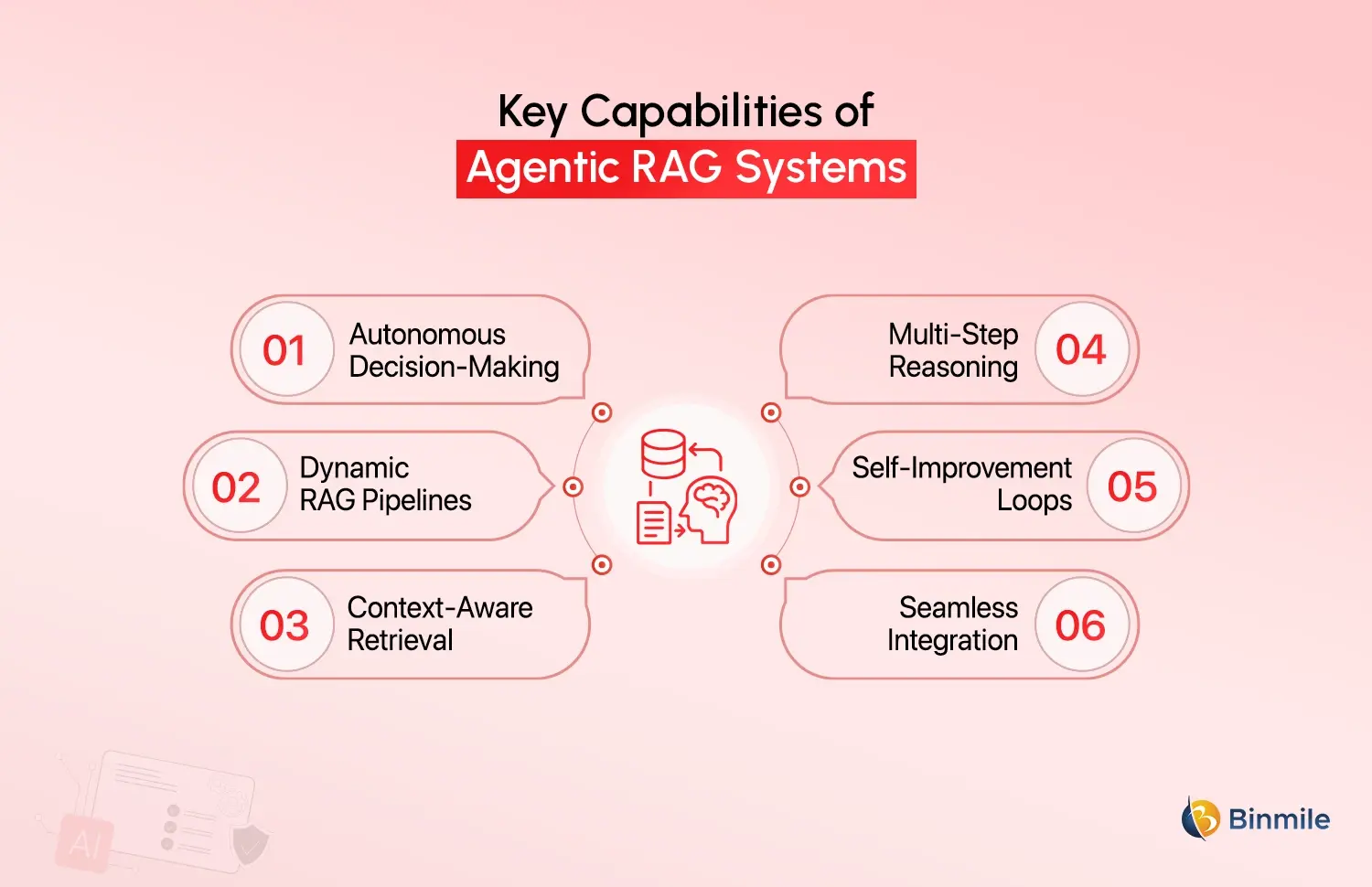
Agentic RAG systems are designed to go beyond static retrieval. Their strength lies in adaptability and intelligence.
-
Autonomous Decision-Making
Autonomous RAG systems have the capacity to make independent decisions concerning the handling of a query. Without relying on standard operating procedures, they analyze the situation and choose the most appropriate action. This drastically increases operational speed and lessens the reliance on human input.
-
Dynamic RAG Pipelines
In contrast to typical RAG systems, which are rigid, agentic systems are flexible. The query require more validation or a more sophisticated analysis? The system can dynamically extend the pipeline to meet the requirements.
-
Context-Aware Retrieval
The systems use more advanced technology than simply retrieving information through the use of synonyms. They understand the meaning and purpose of a query, which allows them to search, find, and retrieve the most relevant and accurate information.
-
Multi-Step Reasoning
In addition to performing multi-step reasoning, agentic RAG applications are capable of solving all intermediate steps and processing them in a logical order, which also entails that the system will ultimately yield a coherent and comprehensible output.
-
Self-Improvement Loops
One of the more advanced capabilities of the system is the ability to self-assess the output and the capacity to make improvements. The system will continuously learn from the output, which alters the system for the purpose of improving performance.
-
Seamless Integration
Agentic RAG systems can be incorporated into current ecosystems, whether those be AI development workflows, machine learning models, or data engineering frameworks. This allows for easier adoption without the need for complete revisioning of current frameworks.
Agentic AI vs Agentic RAG
Although closely related, these two concepts serve different purposes.
| Aspect | Agentic AI | Agentic RAG |
|---|---|---|
| Core Function | Autonomous decision-making | Retrieval + generation with autonomy |
| Focus | Action and reasoning | Knowledge retrieval and response generation |
| Use Case | Task automation | Intelligent knowledge systems |
| Dependency | May not require external data | Strongly depends on RAG technology |
In simple terms, agentic RAG is a specialized application of agentic AI focused on improving knowledge retrieval and generation.
What are the Benefits of Agentic RAG
Adopting agentic retrieval automation generation brings several practical advantages across industries.
-
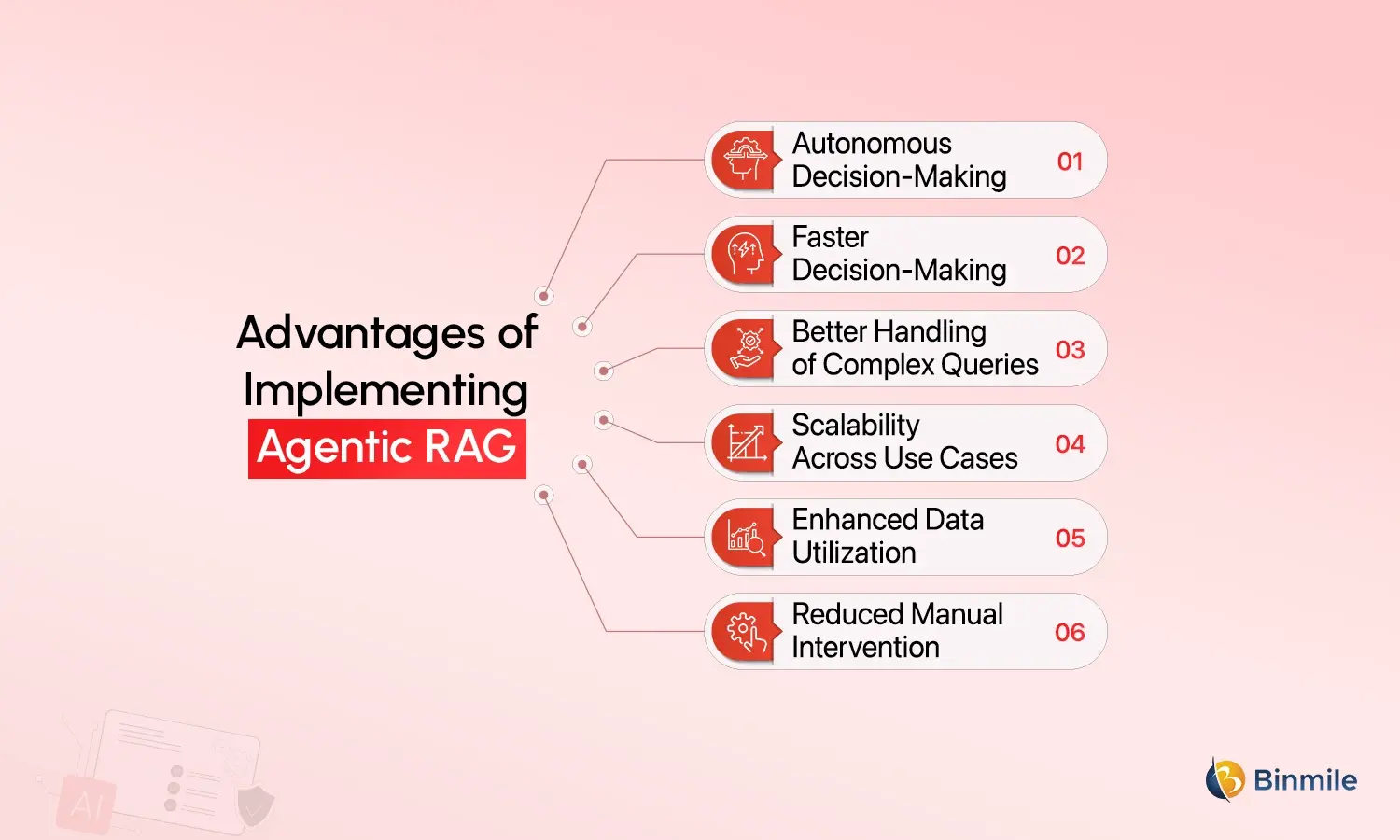
Improved Accuracy and Relevance
Agentic RAG systems continually clarify and change outputs with the goal of ensuring maximum precision and relevance. This is especially useful for data-sensitive situations to curb the odds of irrelevant and incorrect inaccuracies.
-
Faster Decision-Making
Both the retrieval and explanation processes are automated through these systems, which expedites the decision-making processes. This aids businesses in being more decisive as well as swifter.
-
Better Handling of Complex Queries
Isolating and detailing layered and ambiguous requests is notoriously difficult for traditional systems. To alleviate and complete more difficult requests in the framework of stepwise and iterative requests, agentic systems are highly suitable.
-
Scalability Across Use Cases
Irrespective of the limitations of traditional systems, agentic systems are highly adaptable and can be used across customer service and advanced analytics systems. In the case of customer service, traditional systems are far more limited than agentic systems.
-
Enhanced Data Utilization
Enhanced RAG technology creates the possibility of structured data sources combined with unstructured sources, such as emails, documents, and reports. This combination optimizes data sources to their greatest potential.
-
Reduced Manual Intervention
Automation reduces the need for constant human monitoring. This not only saves time but also allows teams to focus on more strategic tasks.
[cta 1]
What are the Core Techniques Behind Agentic RAG
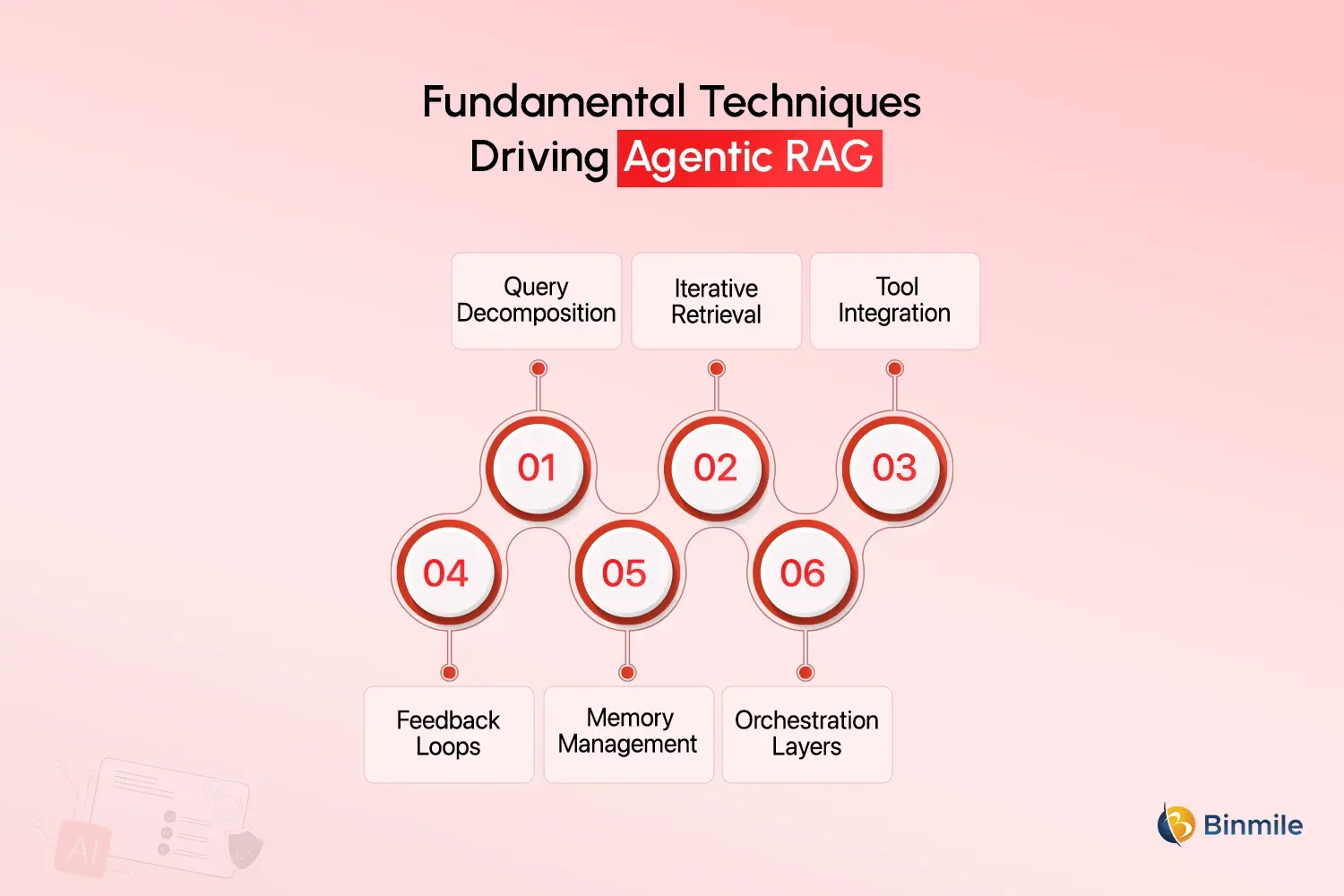
Understanding the underlying techniques is essential for successful agentic RAG implementation.
-
Query Decomposition
Answering queries after breaking the question into different pieces helps the system to provide clearer responses and more specific answers.
-
Iterative Retrieval
Rather than capturing the whole system view into a final dataset, this method uses previously seen data to update the system. It helps to keep the most relevant and up-to-date data.
-
Tool Integration
With agentic RAG systems, external tool integration (like APIs, databases, and enterprise systems) is possible, which permits dynamic data retrieval.
-
Feedback Loops
The system works by evaluating outputs to adjust them to the specifications. Feedback helps to refine and improve the system’s output.
-
Memory Management
Some systems can remember a previous context and provide customized responses. This is important and useful in virtual assistants, customer service, and other systems.
-
Orchestration Layers
These layers are responsible for coordinating the different components of the RAG systems to ensure that all tasks are carried out effectively.
Building an Agentic RAG Architecture
Creating a strong architecture requires combining multiple layers effectively.
1. Data Layer
The data layer includes both structured and unstructured data sources to ensure data is managed appropriately through its whole lifecycle, including returning to its source, so clean data is available when needed.
2. Retrieval Layer
The retrieval layer uses intelligent RAG systems to extract relevant data by developing sophisticated algorithms that work to ensure only relevant data is used by RAG.
3. Reasoning Layer
The reasoning layer is the central component of the AG RAG by provides all of the decision-making capability; determines how to respond to queries; and tells the next steps that will be taken.
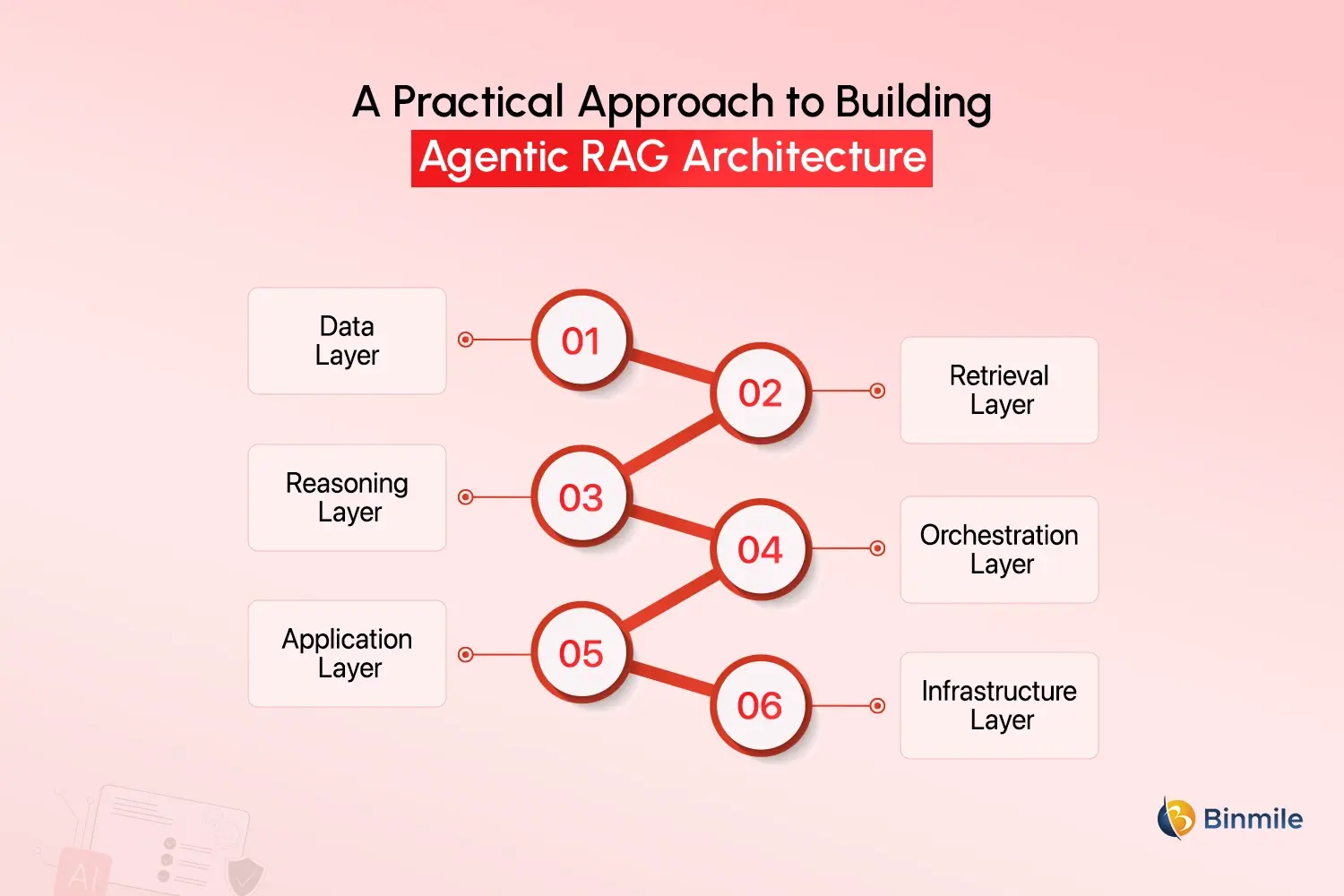
4. Orchestration Layer
The orchestration layer provides all the various parts of the system integrated together so that all workflows operate properly and normally across the entire system.
5. Application Layer
The application provides outputs to the users via various applications, including dashboards, chat interfaces, and enterprise applications.
6. Infrastructure Layer
The infrastructure layer supports the entire system through cloud computing and DevOps consulting to ensure the whole system is scalable, reliable, and performing properly.
What are the Challenges of Agentic RAG
Implementing agentic RAG systems involves a number of difficulties. When workflow processes are adaptive, the challenges are the complexities pertaining to the architecture design. This is opposed to the more adjustable nature of traditional RAG models, and alarming design and engineering concerns.
Continuous reasoning, iterative retrieval, and the subsequent increased computational costs can present additional challenges. If not properly accounted for, these challenges can also affect the overall system scalability. The retention and the system’s ability to yield favorable results also hinge on the quality of accurate and complete data within the system.
Extant systems, including cloud consulting and DevOps consulting, can prove to be a challenge for organizations with legacy systems, especially when integrating with agentic systems. There must also be transparency, compliance, and reliability in relation to the governance and control of autonomous decision-making processes.
What are the Applications of Agentic RAG
Agentic RAG assists with the quicker decision-making processes in multiple industries. In the healthcare industry, their system analyzes patient data in conjunction with their system, assisting in higher accuracy diagnostics. In finance, RAG systems analyze data at an efficient rate, which assists in the detection of fraudulent patterns as well as generating deeper insights into investments.
For instance, in RAG eCommerce systems, the agentic capability improves on and analyzes the personalized recommendations in relation to user behavior. In document analysis and case research, RAG systems positively assist in the reduction of efforts that are manual in nature. In digital strategies that transform the workflow in operations, RAG systems positively automate the efforts and overall efficiency.
Looking to build intelligent AI systems that go beyond basic automation? Explore how Agentic RAG can transform your business workflows.
How Binmile Can Support Your Agentic RAG Journey
When organizations begin to build agentic RAG systems, they may encounter difficulties in architectural design, integration, and scalability, particularly when moving from traditional RAG systems to more advanced systems. Here, specific knowledge makes a considerably greater impact. Binmile, with considerable ability in the research and development of artificial intelligence, data engineering solutions, and digital transformation, assists clients in building systems that are advanced, practical, and scalable.
The aim is to construct agentic RAG pipelines that are efficient and meet business goals, as well as implement agentic AI that improves business decision-making. Whether it is the enhancement of the data lifecycle, cloud consulting, and DevOps consulting to facilitate agile deployment, or any other aspect, the approach is designed to aid organizations in making the most of Agentic RAG and excluding any unnecessary complications.
Frequently Asked Questions
Agentic RAG combines retrieval-augmented generation with autonomous decision-making. Unlike traditional RAG, which follows a fixed pipeline, it dynamically decides how to retrieve, process, and refine information, making it more flexible and context-aware.
Industries like healthcare, finance, eCommerce, and legal services benefit the most. These sectors require accurate data retrieval, complex reasoning, and real-time insights, which agentic RAG systems can efficiently deliver.
Agentic RAG performs better than traditional models in handling complex queries, delivering more accurate responses, and adapting to dynamic data. Its ability to refine outputs continuously improves overall efficiency and reliability.
Look for expertise in AI development, machine learning, and data engineering solutions. The right partner should also have experience in cloud consulting, DevOps consulting, and building scalable RAG pipelines tailored to business needs.
Agentic Graph RAG integrates graph-based data structures with agentic RAG systems. It helps AI understand relationships between data points, improving performance in tasks like recommendation systems, fraud detection, and knowledge graph analysis.
Agentic RAG can be used in customer support, business intelligence, workflow automation, and knowledge management. It is especially useful in organizations focused on digital transformation strategy and data-driven decision-making.