
Digital products are judged within seconds of use. Users decide very quickly whether something feels intuitive, trustworthy, and worth their time. That decision is rarely influenced by features alone. It is shaped by how smoothly the product responds, how clearly information is presented, and how predictable interactions feel. This is why experience has become a measurable business factor rather than a subjective design concern. A Forrester study highlights this shift clearly, showing that every dollar invested in UX can generate returns of up to 100 dollars through higher conversions, reduced friction, and improved loyalty.
As digital ecosystems grow more complex, delivering a strong user experience requires more than good design intentions. Visual concepts often break when translated into real-world systems due to performance constraints, inconsistent development practices, or a lack of collaboration. UX engineering has emerged to solve this gap. It brings UX principles, UI engineering, and scalable software practices together to create experiences that not only look good but also work reliably.
This blog explores what UX engineering is, why it has evolved into a growth strategy, how it differs from UX design, where it fits in product development, the challenges businesses face, and how long-term value is created when UX engineering is done right.
What is UX Engineering?
UX engineering is the discipline responsible for ensuring that user experience survives the transition from concept to code. It focuses on how interfaces behave in real environments, under real usage conditions, across devices, platforms, and user expectations.
A UX engineer sits between design and development. While designers define what the experience should be, and developers focus on making features function, UX engineers ensure that the experience behaves exactly as intended once it reaches users.
A UX software engineer typically works with frontend technologies, component libraries, accessibility guidelines, performance optimization techniques, and design systems. Their work ensures that UI/UX design does not degrade due to technical shortcuts or inconsistent implementation.
Core responsibilities within UX engineering include translating UI/UX design into scalable code, embedding UX principles into development decisions, supporting UI engineering for long-term scalability, and aligning design intent with engineering reality. This role is often filled by professionals titled UX engineer, UI/UX engineer, UI/UX design engineer, or UI/UX software developer, depending on the organizational structure.
Why is UX Engineering Becoming a Growth Strategy?
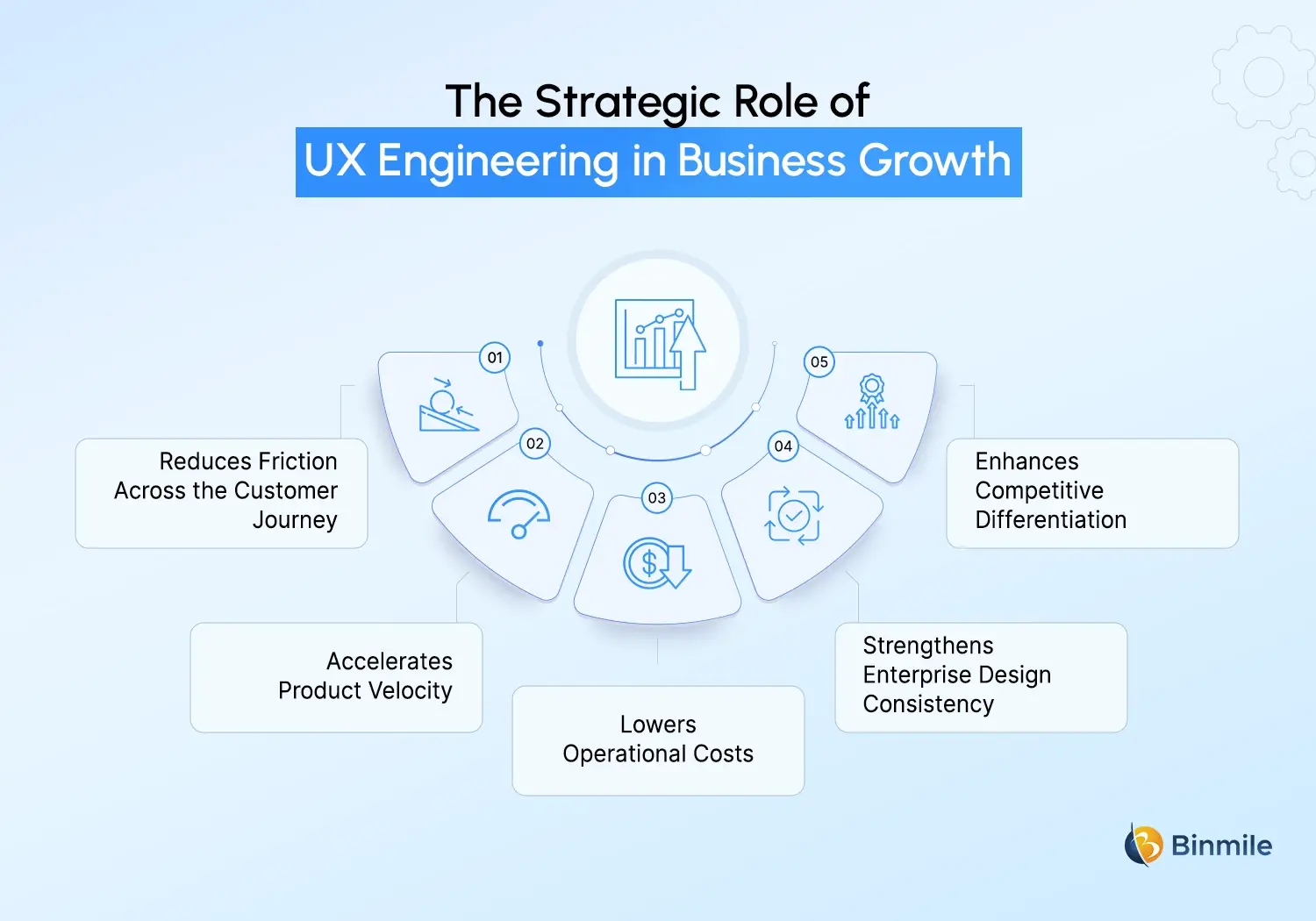
UX engineering has gained strategic importance because user expectations are evolving faster than traditional development models. Enterprise systems are expected to deliver consumer-level simplicity, and when they fail, growth stalls. Here is why UX engineering has become a growth strategy:
-
Reduces Friction Across the Customer Journey
UX engineers focus on creating clarity, predictability, and feedback in every interaction. Users are aware of what is happening and what to do next, which reduces errors, confusion, and frustration. This makes the product feel intuitive and builds trust over time.
-
Accelerates Product Velocity
When UX strategies are embedded into UI engineering from the beginning, teams spend far less time fixing usability issues after release. This frees up effort to focus on delivering new features instead of revisiting old problems.
-
Lowers Operational Costs
Products designed and implemented with strong UX engineering principles require fewer redesigns, fewer support interventions, and less rework. This reduces both technical debt and maintenance costs over time.
-
Strengthens Enterprise Design Consistency
Large organizations often have multiple teams contributing to the same platform. UX engineering ensures that the user experience remains coherent, preventing fragmented or inconsistent designs across products and services.
-
Enhances Competitive Differentiation
Businesses that invest in UX engineering deliver experiences that delight users. This builds loyalty, increases retention, and positions the product as a market leader, making UX engineering a direct driver of growth.
What are the Differences Between UX Design and UX Engineering
UX design and UX engineering complement each other but serve distinct purposes. Confusing them can lead to misalignment, inefficiencies, or degraded experiences. Here is a more explanatory comparison:
| Aspect | UX Design | UX Engineering |
|---|---|---|
| Primary Objective | Define the user experience, identify what users need, and map their journeys | Deliver the designed experience in production, ensuring it works reliably across platforms |
| Core Focus | User research, interaction concepts, usability testing, and creating flows | UI engineering, frontend development, performance optimization, accessibility, and implementing design systems |
| Typical Tools | UI/UX design tools like Figma, Sketch, and Adobe XD | Frontend frameworks, component libraries, codebases, and design system management tools |
| Output | Wireframes, prototypes, and visual systems that represent the intended experience | Functional, scalable UI components and systems that make the experience operational and consistent |
| Business Impact | Shapes perception and sets expectations for the product | Ensures experience consistency, reduces technical debt, and protects the design as products scale |
Without UX engineering, even strong UX design can degrade due to performance bottlenecks, inconsistent implementation, or technical limitations. UX engineering safeguards the user experience as products grow and evolve.
Trying to scale your product experience without slowing down development or increasing rework?

What are the Challenges in Implementing UX Engineering
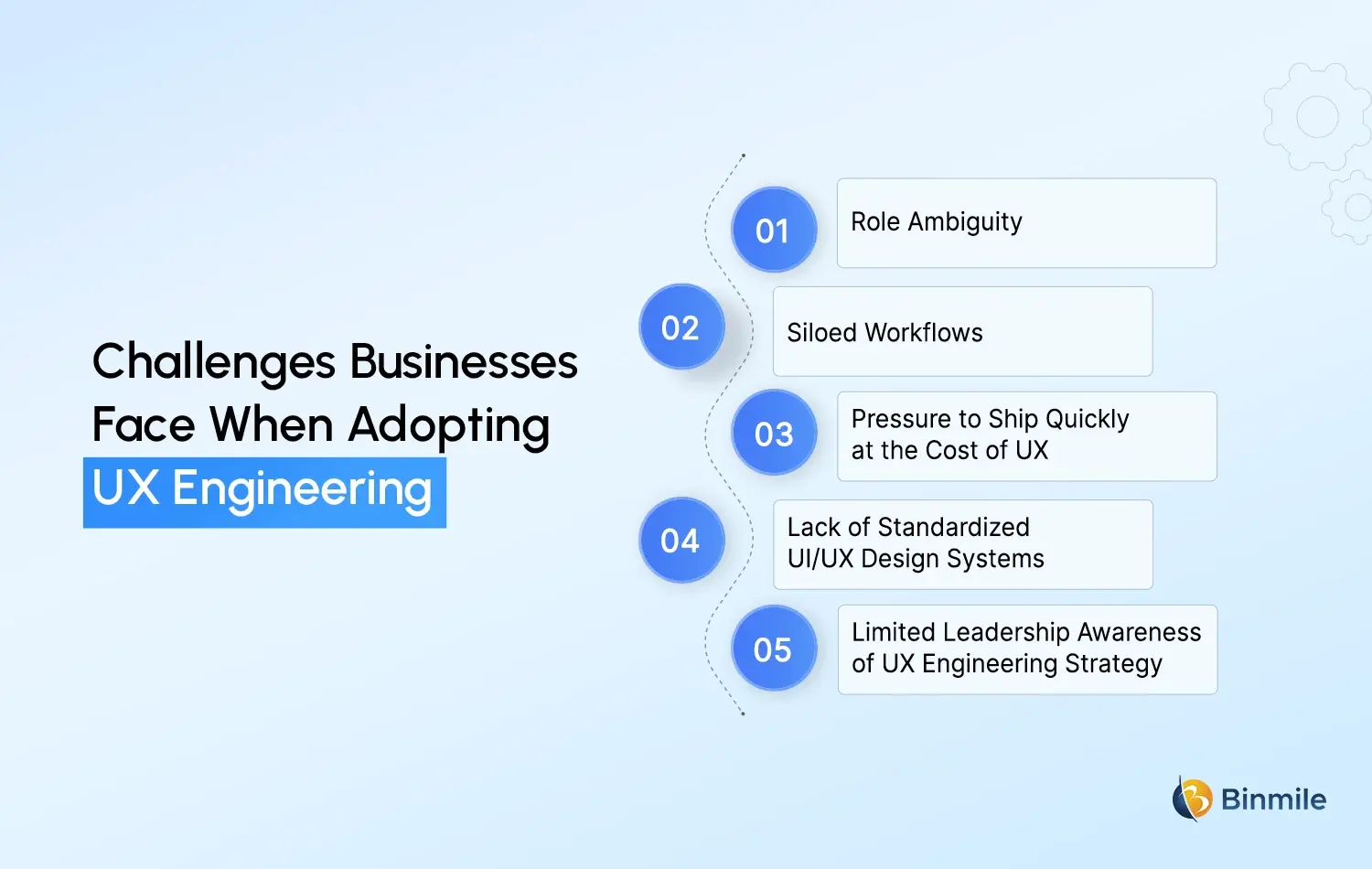
Even with its benefits, implementing UX engineering can be challenging. Here is a breakdown of common obstacles:
-
Role Ambiguity
UX engineers often exist between design and development teams, which can confuse ownership, responsibilities, and accountability.
-
Siloed Workflows
Designers may create static mockups without considering technical feasibility, while developers prioritize speed over experience. This misalignment can lead to inconsistent implementations.
-
Pressure to Ship Quickly at the Cost of UX
Tight deadlines sometimes force teams to compromise on experience quality, which can negatively impact adoption and retention.
-
Lack of Standardized UI/UX Design Systems
Without a cohesive design system, multiple teams might implement interfaces differently, causing fragmentation and a degraded user experience.
-
Limited Leadership Awareness of UX Engineering Strategy
When decision-makers do not understand the UX engineering strategy, it becomes harder to secure the necessary investment and alignment.
Overcoming these challenges requires organizational alignment, leadership buy-in, and recognition that UX engineering is a long-term investment rather than a one-time effort.
Where Does UX Engineering Fit in the Product Development Cycle?
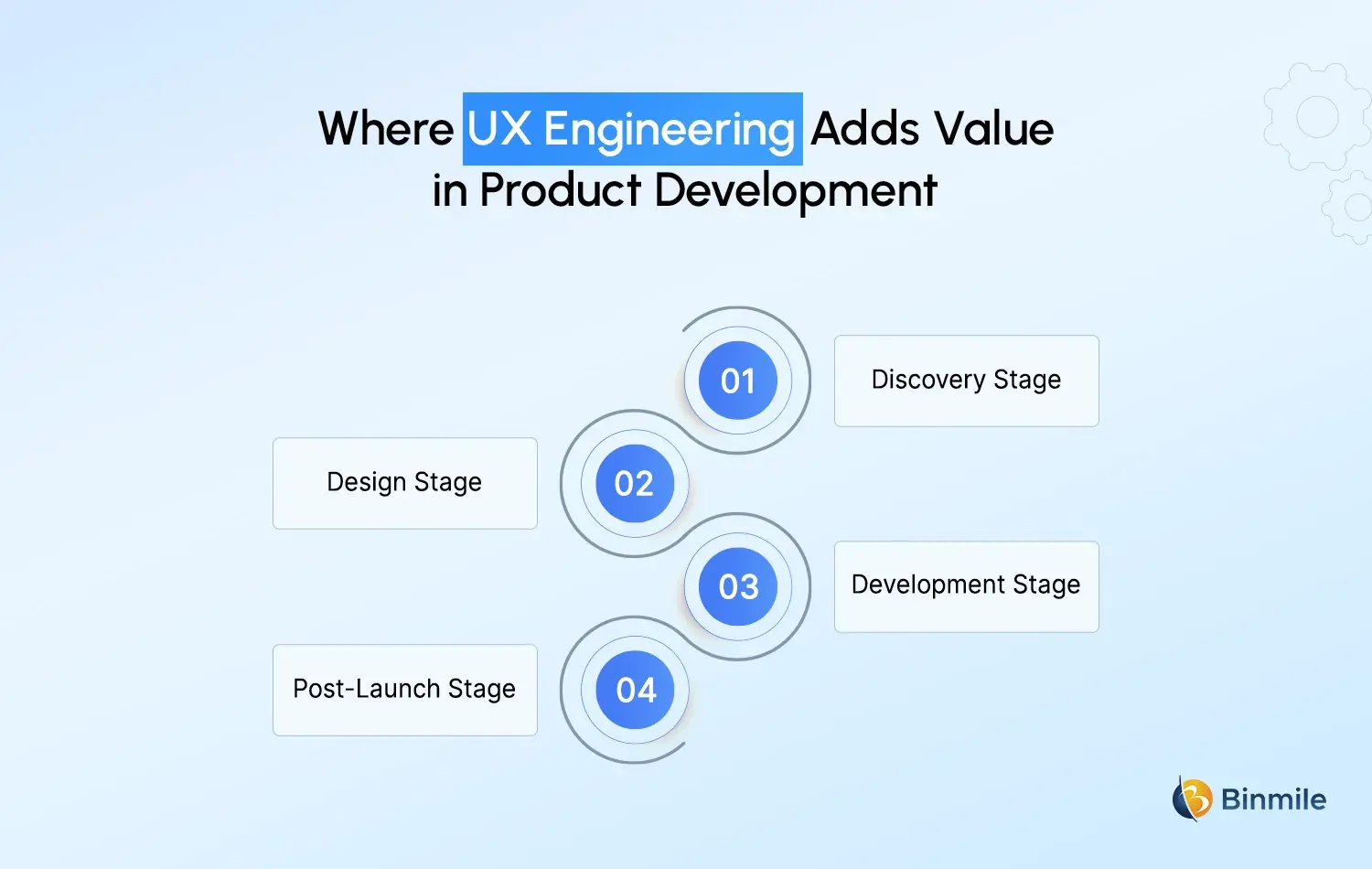
UX engineering is not a final-stage activity; it is integrated into the entire product lifecycle. Here is how it fits at every stage:
-
Discovery Stage
UX engineers collaborate on the UX product vision, feasibility, and user research. They help identify potential technical constraints early, ensuring the concept is scalable and realistic before resources are committed.
-
Design Stage
Working alongside designers using UI/UX design tools, UX engineers validate components, interactions, and responsiveness. They ensure that the designs are technically feasible and maintain usability across devices.
-
Development Stage
UX software engineers implement the designs, focusing on performance, accessibility, responsiveness, and consistency. This stage ensures the product behaves as intended in real-world environments.
-
Post-Launch Stage
UX engineering supports UI/UX application modernization, refining interactions based on actual user behavior, feedback, and evolving business needs. This helps maintain a high-quality experience over time.
By being embedded throughout the lifecycle, UX engineering ensures a product is not only visually appealing but also functional, reliable, and scalable.
Planning a UI/UX modernization that supports growth rather than creating complexity?

How the Right Partner Strengthens UX Engineering Outcomes
Strong UX engineering requires a combination of structured processes, cross-functional collaboration, and domain expertise. Organizations that integrate design thinking in software development with robust UI engineering practices deliver more stable, scalable, and effective products.
A partner like Binmile can help organizations align UX engineering with enterprise design, digital product development, and custom software development objectives. Their approach focuses on building consistent interfaces, reusable UI architectures, and experience-driven solutions. This ensures products modernize effectively while maintaining performance, usability, and scalability. By balancing user-centered design with engineering discipline, businesses can achieve growth while delivering meaningful, seamless experiences.
Frequently Asked Questions
Yes. UX engineering ensures enterprise platforms remain usable, scalable, and consistent. It improves adoption, reduces friction, and supports long-term digital transformation initiatives.
It addresses usability gaps, inconsistent interfaces, performance issues, and design-to-development misalignment that often emerge as products scale.
Success can be measured through improved conversion rates, reduced support tickets, faster development cycles, increased engagement, and higher customer retention.
Yes. Strong UI/UX design builds credibility early. UX engineering ensures those experiences remain consistent and scalable as the business grows.
Such UI/UX design services partners bring proven UX strategies, UI engineering expertise, and structured processes that reduce risk and accelerate delivery.
Modern UX engineering relies on UI/UX design tools, frontend frameworks, design systems, accessibility standards, and performance optimization tools.
By delivering reliable, intuitive, and consistent experiences, UX engineering reduces frustration and builds trust, encouraging long-term usage.