Artificial intelligence has moved out of the experimental phase into the mainstream. McKinsey reports that almost 78% of companies have integrated AI into one or more business functions. This number is growing rapidly.
This illustrates the urgency of the business need. Companies without a well-defined Enterprise AI Strategy for innovation, intelligence, and operational efficiency will find themselves outperformed by their peers who have integrated AI into their processes. In this blog, we will discuss in detail what an enterprise AI strategy is, how to create one, and the implementation process, one step at a time. We keep the explanation of risks, key components, industry use cases, and ROI measurement practical, simple, and straight to the point.
What is an Enterprise AI Strategy?
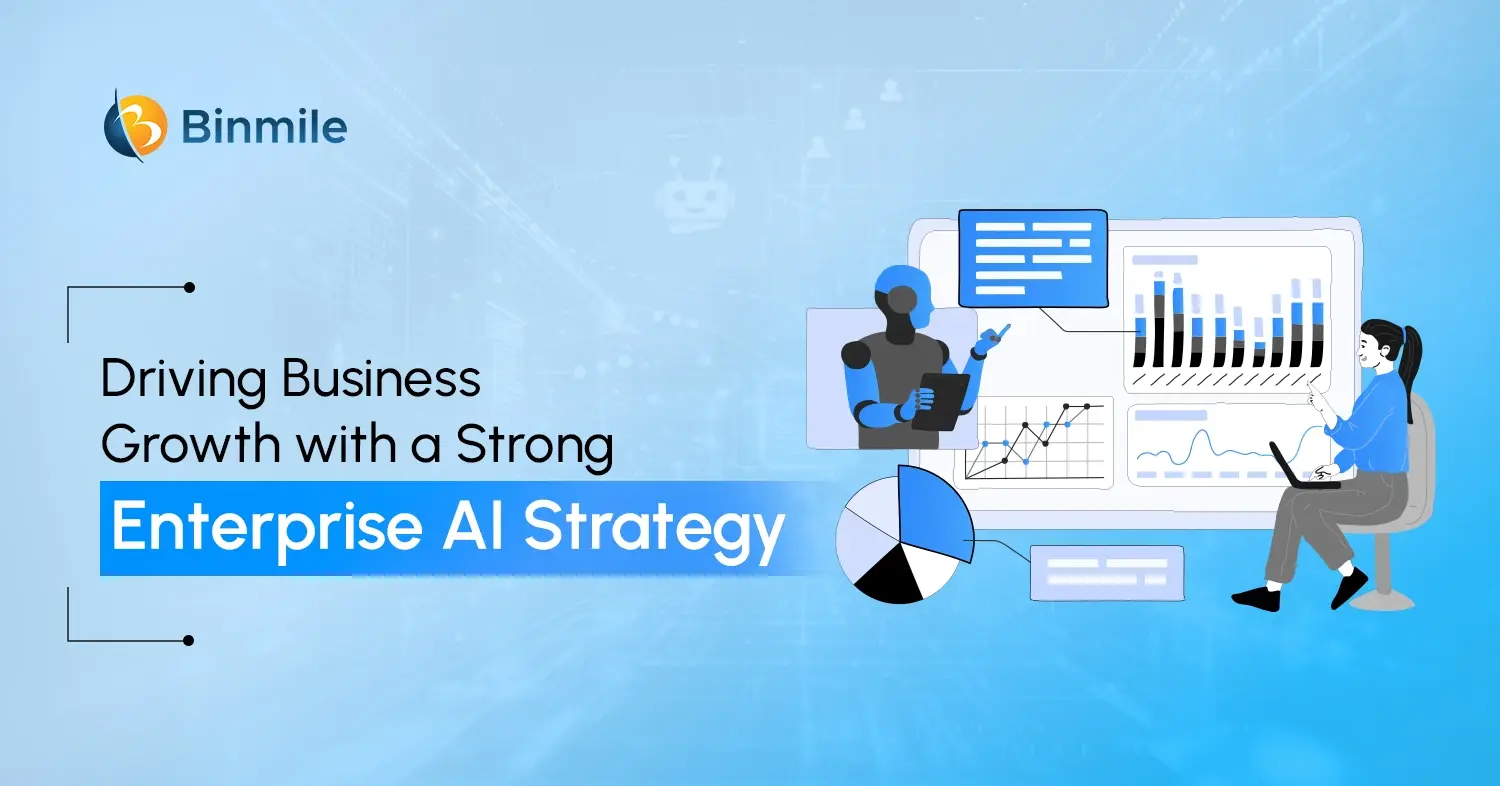
An Enterprise AI Strategy is a structured plan that defines how an organization will adopt, implement, and scale artificial intelligence across its operations. It aligns AI initiatives with business goals, ensuring that investments deliver measurable value and support long-term AI development efforts.
It is not just about adopting tools or building models. Additionally, it is about creating a long-term vision where AI supports decision-making, improves efficiency, and drives innovation across departments.
A well-defined AI strategy connects multiple elements such as data, technology, talent, and governance into a unified direction. Without this alignment, AI efforts often remain scattered and fail to produce meaningful outcomes.
Why Businesses Need an Enterprise AI Strategy
Most businesses tend to begin their AI projects without having a plan. This leads to budget wastage, poor integration of systems, and adopting the AI systems being very hard.
Strong company-wide strategies permit and enable businesses to integrate their AI projects easily with their new and refined business goals. This ensures that all of the goals set for the future of the business are achieved. With a refined and modernized AI system integrated into the processes of the business, the data and information collected will be able to prove and assist with eliminating gaps and simplifying the processes of the business.
Furthermore, a clear approach to AI allows companies to implement it across various departments rather than being confined to singular, isolated instances. The strategy also directly improves risk management by integrating elements to address issues such as data privacy, bias, and compliance through a structured AI governance framework. Ultimately, those companies that are clear about their AI business strategy and execution are able to innovate and sustain a competitive advantage faster.
What is the Step-by-Step Guide to Building an Enterprise AI Strategy
Creating an effective AI strategy requires a structured and practical approach. Below is a step-by-step breakdown that business leaders can follow.
Step 1: Define Business Objectives
Begin by determining what problems you would want to solve with AI. These problems can be centered on improving customer experience, decreasing operational costs, or improving forecasting accuracy. Instead of beginning with technology, starting with the business objectives would be best, as this would be the most relevant and impactful.
Step 2: Assess AI Readiness
You need to analyze your organization’s available capabilities and potential obstacles prior to implementing your plan. This will help you understand the quality of the available data, assess the technological infrastructure you have, understand the knowledge and skills of your workforce, and analyze the overall attitude of the organization towards AI. This is what is called the AI readiness, and it is the single most important factor to consider if you want to successfully implement your AI strategy and later upgrade your Gen AI strategy effectively.
Step 3: Build a Strong Data Foundation
The success of AI highly depends on the availability of quality data. If the data is not accessible and is not well organized and cleaned, even the most sophisticated AI models will not yield positive results. This is why organizations must focus on the integration of data from various sources, solid data governance, and data security. A well-organized data foundation will complement enterprise cloud strategy and result in the successful, scaling, and secure operation of AI, including digital twin software, within your organization.
Step 4: Choose the Right Enterprise AI Platform
Your choice of enterprise AI platform can impact success many years in the future, and the right decision will center around its ability to provide seamless integrations and adaptable flexibility to changing business demands in the future, including fast model development and deployment, strong security and compliance, and AI as a Service. This will allow your enterprise strategy to focus on future goals, rather than being limited to the results of the short term, and support advanced systems like agentic AI architecture.
Step 5: Develop AI Use Cases
For early value realization, it is essential to identify appropriate use cases. Companies should prioritize predictive analytics, AI-based customer service assistants, fraud detection, and personalized marketing, for example. Starting with a few, manageable, small projects will allow an organization to gauge effectiveness and then expand on successful concepts.
Step 6: Create an AI Implementation Strategy
In order for there to be structure and order, there must be a defined AI implementation strategy. This means describing timelines, milestones, roles, responsibilities, budgeting, and success metrics. Organizations should expect smaller, defined steps in a shorter time frame.
Step 7: Focus on Governance and Ethics
Transparency and fairness must be the hallmarks of AI. Governance allows organizations to focus on data privacy, AI model bias, regulatory compliance, and trust. Governance is a legal obligation, but it is also a necessity for the success of AI strategies.
Step 8: Upskill Teams and Build AI Culture
Transformation is complex. AI strategies will fail without a significant commitment to people. AI tools and concepts must be taught to employees, and data-driven decisions must be encouraged. Additionally, a stronger connection between technical and business groups must be established. Culture change will enable AI success beyond a standalone function to an integrated element of operational processes.
What are the Industries That Benefit the Most
Using AI in marketing benefits all businesses and industries. However, there are some industries that are benefiting more than others, as they have a more data-driven start. These industries are healthcare marketing, financial marketing, retail marketing, manufacturing, and marketing logistics. Using AI in healthcare helps improve diagnosis and patient care, and helps healthcare workers perform their jobs more efficiently. Additionally, using AI in financial marketing helps in detecting fraud, assessing risks, and making financial transactions more accurate and faster.
Using AI in retail marketing helps businesses understand their customers’ demands, which in turn drives more sales and improves customer satisfaction. AI in manufacturing is used to predict breakdowns and help reduce machine breakdowns. AI is also used in marketing logistics. Additionally, it helps businesses to deliver their products to customers more quickly and for less money. The goal of all the industries mentioned above should be to use AI more to improve the efficiency and productivity of businesses.
Ready to turn AI ideas into measurable results for your business and explore tailored AI solutions?
What is the Role of AI in Business Strategy
AI in business strategy is no longer a separate function. It is becoming deeply integrated into overall business planning and execution.
-
AI in Marketing Strategy
Using AI in marketing helps users’ businesses to create personalized marketing experiences for their customers. It helps marketers to understand the behaviors of their customers, which helps in optimizing their marketing efforts. Additionally, AI technology helps businesses to create more targeted marketing campaigns as it predicts what works and what doesn’t, instead of relying on guesses.
-
AI in Operations
Using AI improves the efficiency of businesses as it helps in reducing the number of repetitive tasks that are part of their everyday operations. AI helps in optimizing supply chains, which helps in reducing costs. AI helps in streamlining workflows by reducing human error. This makes sure that human resources can be used to create a more efficient process.
-
AI in Decision-Making
Using AI in business decision-making is very helpful as it allows businesses to analyze future behaviors and assess the risks involved. Additionally, using AI helps businesses to make more logical and faster decisions, as AI helps in recognizing trends in markets.
What are the Key Components of an Enterprise AI Strategy
A successful AI strategy is built on several interconnected components that together create a strong foundation for implementation and scalability.
-
Data Strategy
Ensuring that data is of high quality, is structured, and is accessible throughout the organization. Also encompasses the governance and security measures that support the generation of reliable and defensible AI outputs.
-
Technology Infrastructure
The systems and platforms that are necessary to construct and expand AI. Additionally, including enterprise AI systems, cloud systems, and existing business systems.
-
AI Models and Tools
The right set of AI model development tools and model deployment tools. Additionally, model monitoring tools allow performance, precision, and scalability to be achieved and assured over time.
-
Talent and Skills
The requirement for effective AI professionals and ongoing upskilling of present staff to construct, administer, and utilize AI in a competent manner.
-
Governance Framework
The framework that ensures that AI is used ethically and responsibly, including data privacy, regulatory compliance, risk management, and bias reduction in AI systems.
-
Business Alignment
Ensuring that AI initiatives are focused on business objectives and assisting businesses in achieving tangible results such as growth, efficiency, and enhanced decision-making.
What are the Common Risks in AI Adoption
Although AI has some benefits, there are some challenges that businesses have to handle and face ahead of time. One of the main issues and first concerns is the privacy of data since managing sensitive data requires abiding by the compliance guidelines of laws and regulations. Another chief concern is bias in the AI models, which is mostly due to the data being of poor quality. This results in the AIs having unfair and inaccurate results.
Most businesses are also limited by the costs of implementation, which can be high, and for some businesses, they need to put in a lot of money for the infrastructure and skilled professionals. Speaking about professionals, a lot of businesses are challenged by the diminishing number of professionals who have experience in AI. In addition, the existing AI systems are very time and labor-intensive to integrate into the processes of the business that are already present. Additionally, by having a well-thought-out AI strategy to implement, the business will be able to achieve its goals of having minimal AI-related challenges.
Looking to build a scalable enterprise AI strategy that delivers real business impact and start your AI transformation journey?
How Binmile Can Support Your AI Journey
Creating an efficient AI strategy for an enterprise goes beyond having the right AI tools. It takes the appropriate combination of technology, expertise, and execution ability. In the case of AI consulting for digital transformation, Binmile is one of the organizations that helps businesses transition from theoretical frameworks to practical implementation in an organized and results-oriented manner.
It is possible to ensure that every AI initiative is tied to a business goal that has economic significance. Whether agentic AI architecture has to be designed, digital twin software has to be enabled, or enterprises have to be assisted in upgrading Gen AI strategy, the focus is intended to be on economic significance, scale, and sustainable value. Strong AI development and governance allow businesses to embrace AI with confidence.
Assistance across enterprise cloud strategy, implementation strategy, and AI readiness helps organizations establish a “hard” baseline on which to scale initiatives in the future. Additionally, this makes AI transformation a sustainable journey rather than a one-off event.
Frequently Asked Questions
An Enterprise AI Strategy is a structured plan that helps organizations adopt and scale artificial intelligence across business functions. It aligns AI initiatives with business goals to improve efficiency, decision-making, and overall performance.
Businesses need it to ensure AI investments deliver real value. It helps align technology with goals, reduce risks, improve decision-making, and enable scalable AI adoption across departments instead of isolated projects.
Start by defining business objectives, assessing AI readiness, building a strong data foundation, choosing the right platform, identifying use cases, and creating a clear implementation roadmap with governance and performance tracking.
Key components include data strategy, technology infrastructure, AI tools, skilled talent, governance framework, and alignment with business goals. These elements work together to ensure successful AI adoption and scalability.
Industries like healthcare, finance, retail, manufacturing, and logistics benefit the most. They use AI for automation, predictive insights, customer personalization, and improving operational efficiency.
Implementation timelines vary depending on complexity. Small projects may take a few months, while full-scale enterprise AI transformation can take one to three years with phased execution.
Common risks include data privacy issues, biased models, high costs, lack of skilled talent, and integration challenges. These can be managed with proper planning, governance, and a structured implementation strategy.
ROI is measured through cost savings, revenue growth, improved efficiency, customer satisfaction, and faster decision-making. Both financial and non-financial metrics should be tracked regularly for accurate evaluation.