Enterprise leaders are no longer asking whether artificial intelligence will shape their operations, but how effectively it can be scaled across teams, systems, and workflows. According to McKinsey, organizations that fully integrate AI into their core processes can increase productivity by up to 40 percent, yet only a small fraction manage to operationalize AI at scale due to fragmented systems and a lack of coordination.
This gap between AI potential and real business impact is where enterprise AI orchestration becomes critical. This blog explores what AI orchestration means in an enterprise setting, how it differs from standalone AI technologies, the benefits it delivers, the challenges it solves, and real-world use cases that show why orchestration is becoming foundational to enterprise artificial intelligence strategies.
What is AI Orchestration?
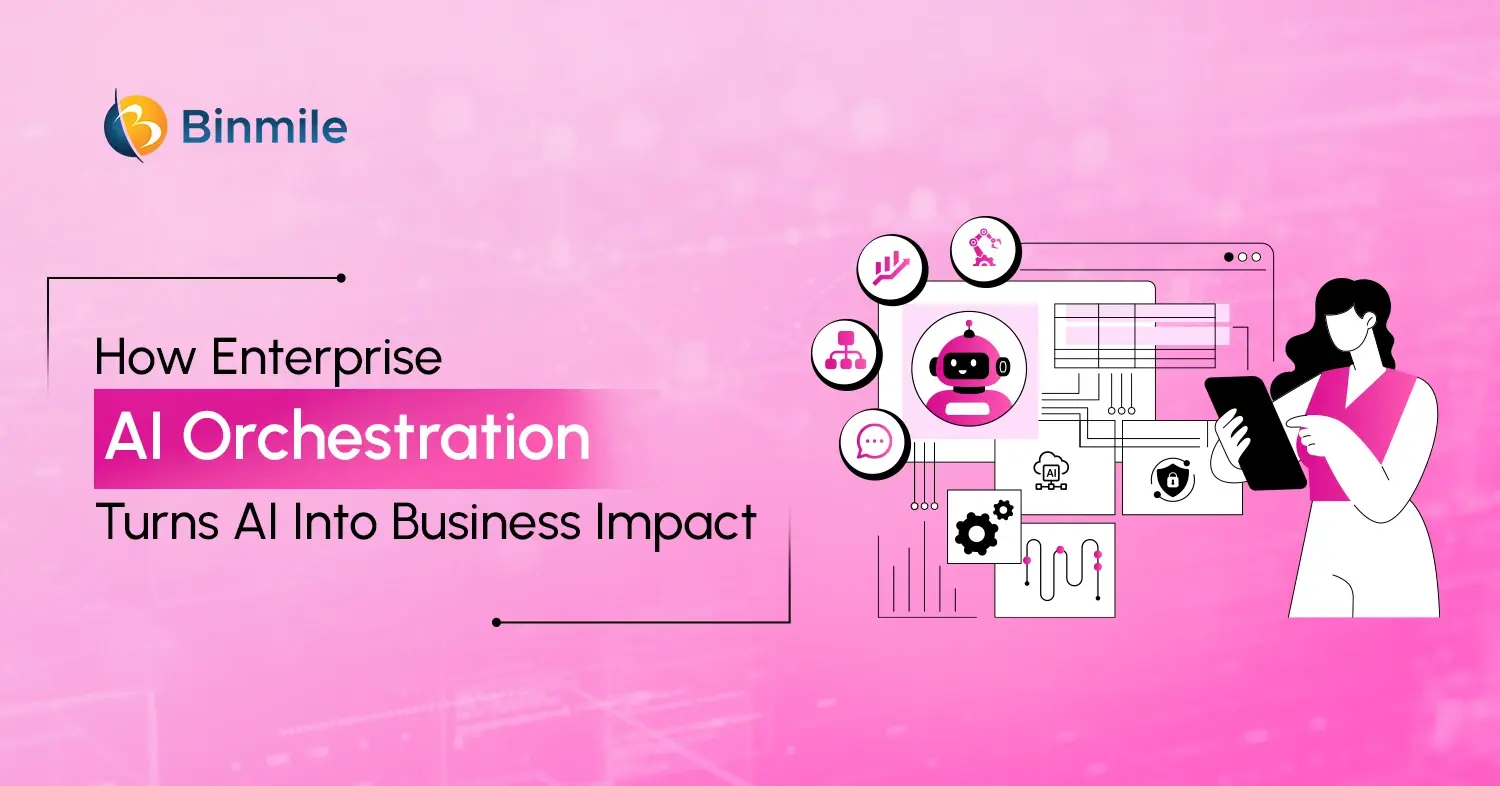
AI orchestration refers to the structured coordination of multiple AI learning models, tools, agents, and data pipelines. Also, enterprise systems work together as one unified workflow. Instead of isolated AI initiatives operating independently, orchestration ensures that every AI component communicates. Also, triggers actions and adapts intelligently across the organization.
In terms of enterprise applications of AI, automation is the least of orchestration’s capabilities. It controls inter-model relationships, manages the system’s inputs/outputs, and makes sure the outputs are consistent with the enterprise’s due diligence, business rules, compliance requirements, and operational needs. This is of greater concern as enterprises begin to implement generative AI orchestration and agentic workflow orchestration, with many autonomous agents working together to achieve one goal.
Incorporating AI orchestration with enterprise orchestration layers such as container orchestration and software integration services, and even eCommerce payment orchestration, gives the enterprise a cohesive AI ecosystem and sophisticated capabilities beyond the prototype stage.
What are the Benefits of AI Orchestration in Enterprises
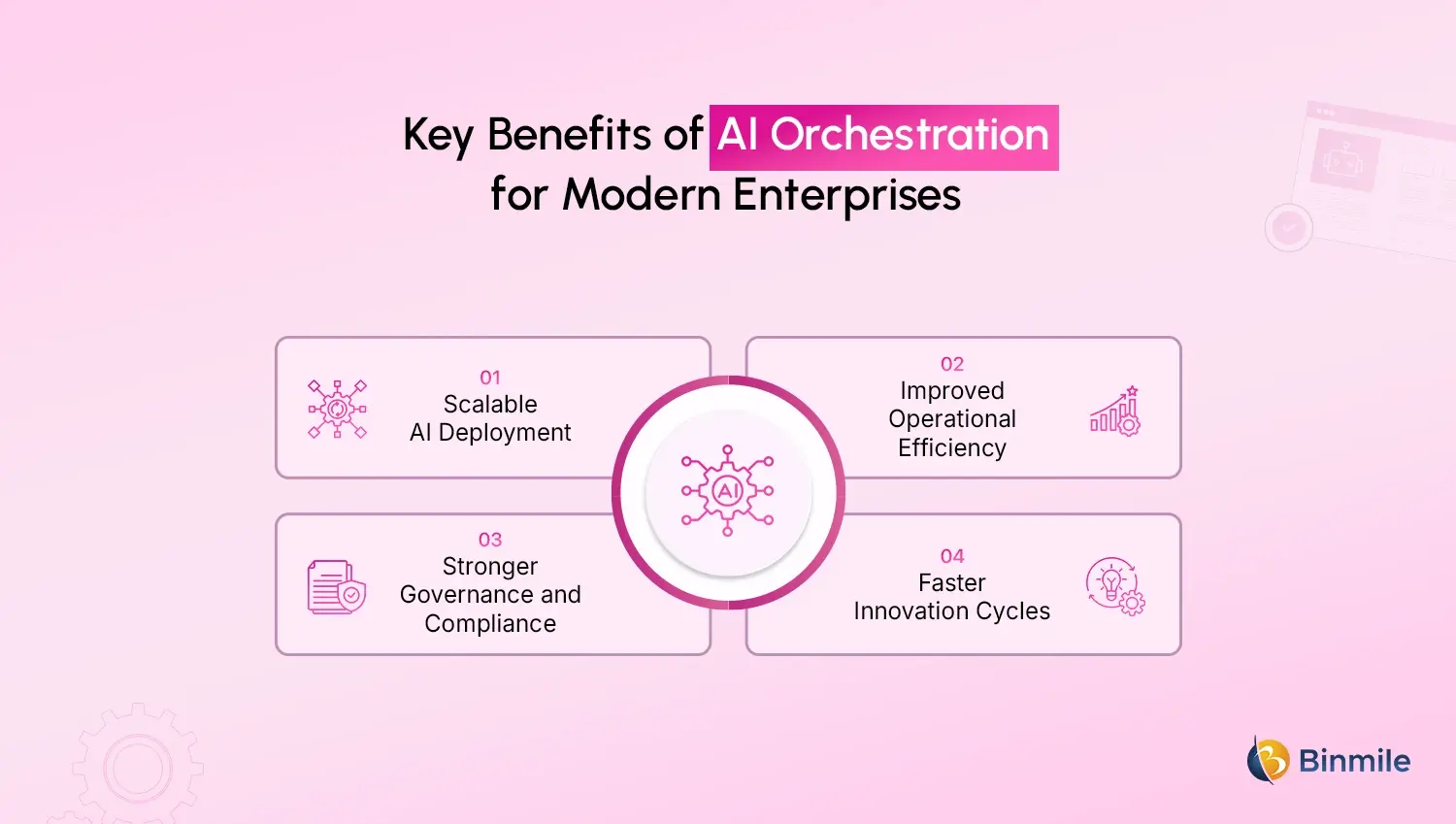
AI orchestration helps enterprises bring structure and consistency to how AI systems operate across teams and platforms. Here are some of the benefits of AI orchestration in the enterprise
-
Scalable AI Deployment
Enterprise orchestration enables companies to deploy, manage, and update AI models across various environments. It does not matter if companies use low-code or no-code tools or custom machine learning pipelines; orchestration allows for an uninterrupted workflow.
Example: A global enterprise running multiple recommendation engines can deploy model updates across regions all at once without downtime while ensuring all models are in compliance with the same deployment standards.
-
Improved Operational Efficiency
AI workflow orchestration reduces and, in some cases, eliminates manual handoffs and redundant workflows across units. By interfacing AI engines with enterprise applications, workflows are completed with improved velocity and accuracy.
Example: A chatbot orchestration lets customer CRM conversations alongside analytics and workflow systems in the background to create tickets instantaneously, resolve issues, and provide responses more quickly and with greater precision.
-
Stronger Governance and Compliance
Centralized supervision provides further control over all data processes, model interactions, and decision-making. Governance and compliance are even more important for highly regulated sectors (e.g., finance and healthcare) where enterprise AI must also be compliant with audit and security policies and ethical considerations.
Example: In the financial services industry, AI orchestration manages and monitors credit risk model compliance for all branch decisions and audit logs against regulatory requirements.
-
Faster Innovation Cycles
Without the need to rebuild an entire framework for model revisions, orchestration enables teams to experiment with and deploy new AI models, agentic AI, and generative AI workflows. Centralized integration, monitoring, and optimization streamline processes to reduce dev overhead.
Example: A retail company can experiment with generative AI to create tailored promotional material while the existing pricing and inventory models run without any interruptions to the orchestration framework.
What Sets AI Orchestration Apart From Other AI Technologies and Capabilities?
Traditional AI tools are made to handle one function in isolation, like predicting, classifying, or recommending. They are effective in the tasks they are designed to perform, but they disconnect when an AI tool is needed to combine on interconnected systems and processes.
AI orchestration becomes the central and primary working mechanism of enterprise AI. It does not replace the existing AI technologies but rather interlinks them, and, unlike robotic process automation platforms, which specialize in singular task automation. Further, AI orchestration enhances the automation with intelligence on the higher levels of decisions, data flows, and workflows of the agents.
Then, there is agentic workflow orchestration that sets apart modern orchestration frameworks. Here, collaborative AI agents act dynamically, choose on the fly which actions to take next, and modify the flow of the workflows in real time. This is different from the common rule-based automation systems and allows for more human-like reasoning to flow across the processes in an enterprise. In summary, AI orchestration does not supersede existing AI learning models, tools of automation, or other technologies. It allows them to combine their powers to function intelligently on a large scale.
Looking to unify AI models, workflows, and enterprise systems into one intelligent ecosystem?
How Orchestration Solves Challenges of AI Scaling
AI orchestration addresses the most common barriers to scaling AI by bringing control, visibility, and standardization across enterprise workflows. Here is the table that explains how AI orchestration solves enterprise AI challenges.
| Enterprise AI Challenges | How AI Orchestration Solves Them |
|---|---|
| Fragmented AI systems across teams | Standardizes interactions between AI models, tools, and data sources to eliminate silo.s |
| Increasing workflow complexity | Provides centralized visibility into dependencies, execution flow, and performance. |
| High infrastructure and computing costs | Optimizes resource usage through efficient model scheduling and container orchestration. |
| Difficulty maintaining model accuracy | Enables continuous monitoring, retraining, and version control of AI learning models. |
| Governance and compliance risks | Enforces consistent policies for data usage, model behavior, and audit readiness. |
Without orchestration, scaling AI becomes inefficient and risky. With orchestration frameworks in place, enterprises gain control, transparency, and sustainability across their AI initiatives.
What are the Real-World Use Cases of AI Orchestration
AI orchestration is widely used across industries to coordinate AI models, systems, and workflows for practical, large-scale applications. Here are some examples of real-world use cases of AI orchestration
-
Customer Experience and Support
Using chatbots can allow customers to get basic automation on things like service tickets and refunds. Additionally, let AI chatbots do basic customer question management across different channels, so that escalation of human issues can be reduced.
-
Financial Services and Risk Management
Utilizing Enterprise AI helps to combat fraud, score suitable risks, and coordinate compliance in one system to provide regulatory-aware, real-time decisions while processing streams seamlessly.

-
Retail and eCommerce
AI Orchestration helps to formulate individualized shopping experiences by linking real-time response behaviors of user systems with eCommerce. Further, integrating systems with recommendations, dynamic pricing, available inventory, and payment.
-
Healthcare Operations
Healthcare operations utilizing orchestration frameworks can augment clinical decision support with stronger AI for diagnosis, patient data integration, and provide optimized scheduling that ensures regulatory compliance and data integrity.
-
Manufacturing and Supply Chain
Defensive AI, coupled with IoT and supply chain logistics, creates systems that flex to changing demand and offer predictive responses to equipment failures, and integrates predictive maintenance into supply chain streams.
Ready to move from isolated AI tools to coordinated enterprise intelligence to deliver real business impact?
Why Enterprise AI Orchestration Matters for Long-Term Growth
Enterprise AI is no longer about isolated intelligence. It is about coordinated intelligence that aligns technology with business strategy. Enterprise AI orchestration provides the structure needed to turn experimentation into measurable impact.
As organizations adopt more AI models, generative AI solutions, and autonomous agents, orchestration becomes the foundation that keeps everything aligned, compliant, and scalable. Without it, AI initiatives remain fragmented and difficult to sustain.
This is where experienced partners play a critical role. Teams like those at Binmile help enterprises design and implement AI orchestration frameworks that align with existing systems, governance requirements, and long-term growth plans. By combining AI development expertise with deep knowledge of software integration services and enterprise workflows, organizations can move confidently from AI adoption to AI maturity without unnecessary disruption.
Frequently Asked Questions
APIs enable communication between systems, while orchestration manages the sequence, logic, and coordination of multiple services. Orchestration controls how APIs, AI models, and workflows interact to achieve a unified business outcome.
Common orchestration tools include platforms for container orchestration, AI workflow orchestration, and enterprise orchestration frameworks. The choice depends on use cases, system complexity, and whether agentic AI capabilities or generative AI workflows are required.
An AI agent orchestration platform manages multiple autonomous AI agents, defining how they collaborate, make decisions, and execute tasks across workflows while maintaining governance, visibility, and performance control.
The future of AI orchestration lies in intelligent, self-adapting systems where agentic workflows dynamically adjust to real-time data, enabling enterprises to automate complex decisions while maintaining transparency and control.
No. AI orchestration is broader and manages multiple AI components and workflows. Agentic automation is a subset that focuses on autonomous agents. Orchestration provides the framework that enables agent-based systems to function cohesively.
Industries with complex workflows, such as finance, healthcare, retail, manufacturing, and logistics, benefit most. These sectors rely on enterprise AI orchestration to coordinate data, models, and systems at scale.
Enterprise AI orchestration services include AI development, AI consulting, workflow design, model integration, governance and compliance setup, monitoring, optimization, and integration with existing enterprise systems.