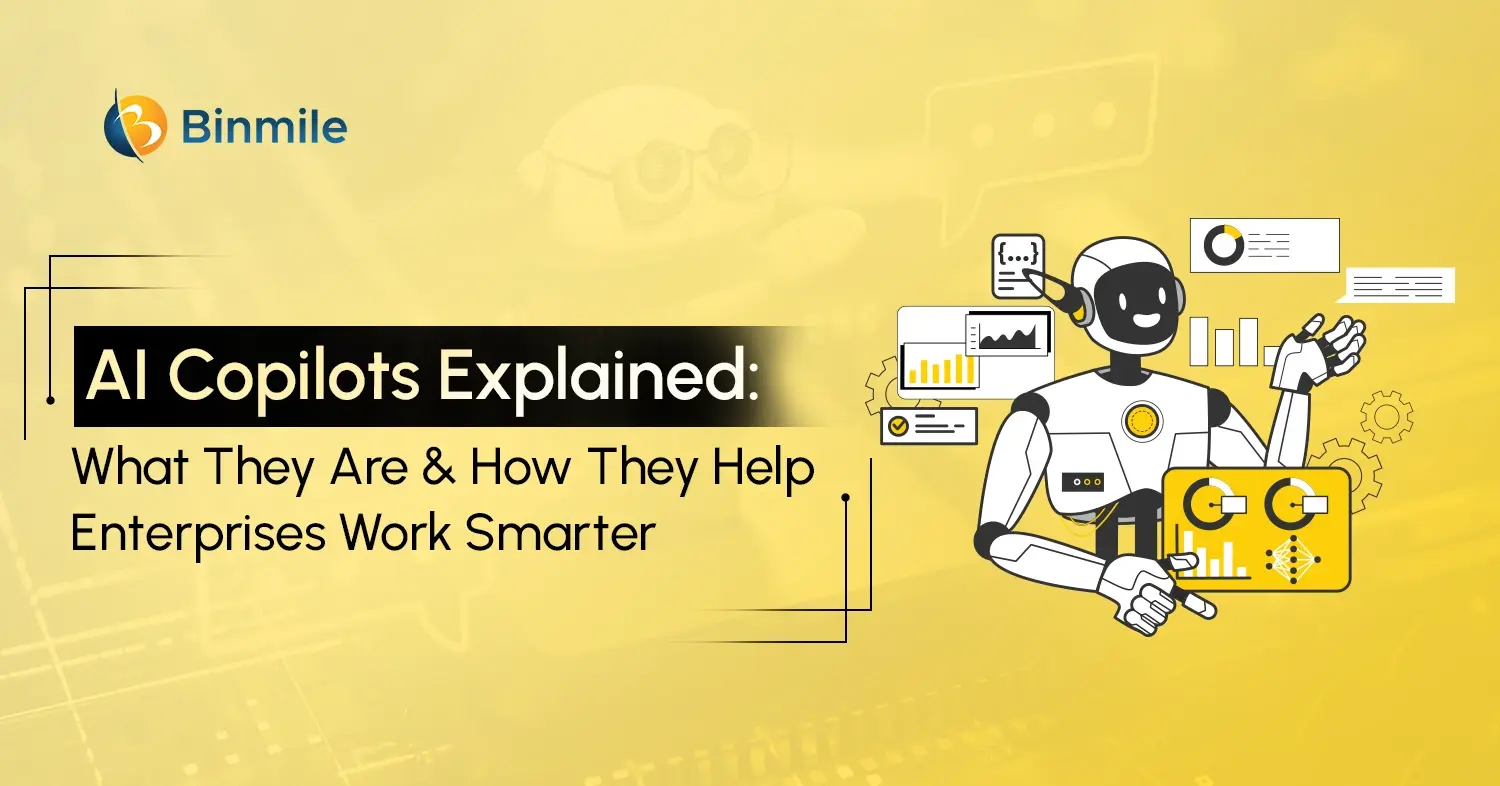
Manual workflows have long been a bottleneck for enterprises striving to scale operations with speed and precision. Today, AI Copilots are changing this reality. According to a recent report by McKinsey, organizations that integrate artificial intelligence into workflows can achieve productivity gains of up to 40 percent in some business functions.
This shift reflects a broader trend of AI adoption across industries, as companies seek smarter ways to handle repetitive tasks and enhance their decision-making capabilities. In this blog, we will explore what AI Copilots are, how they automate processes, and where they deliver the most value. Also, how they improve productivity and efficiency for enterprises.
In the sections that follow, we will define enterprise AI copilots, explain how they replace manual work, highlight real-world AI Copilot examples, identify business functions that benefit most, and discuss productivity gains. We will also examine how organizations can approach AI Copilot development and consider key factors when selecting an AI Copilot development company.
What Are AI Copilots in Enterprise Workflows
At its core, an AI Copilot is a type of intelligent AI assistant designed to support human workers by performing routine tasks, providing contextual guidance, and enhancing decision-making in real time. AI-powered copilots understand user intent using machine learning, natural language processing, and data insights. Unlike traditional software tools, these systems analyze user input and make relevant suggestions. AI Copilot systems can be embedded into existing software tools such as email clients, CRM systems, ERP systems, or customer support tools.
An ERP system with an AI Copilot, for example, can automate the creation of purchase orders and predict when an item will be out of stock. In software development, AI-assisted software development tools like Copilot help programmers by suggesting code, identifying bugs, and improving the speed of development cycles. All of these systems reduce the amount of repetitive tasks required, allowing employees to focus on more important work.
The rise of enterprise AI copilots represents one of the most practical uses of Generative AI tools in business today. These solutions do not replace human expertise but augment it, creating a collaborative human-AI workflow where mundane tasks no longer consume valuable employee time.
How Do AI Copilots Automate Enterprise Processes?
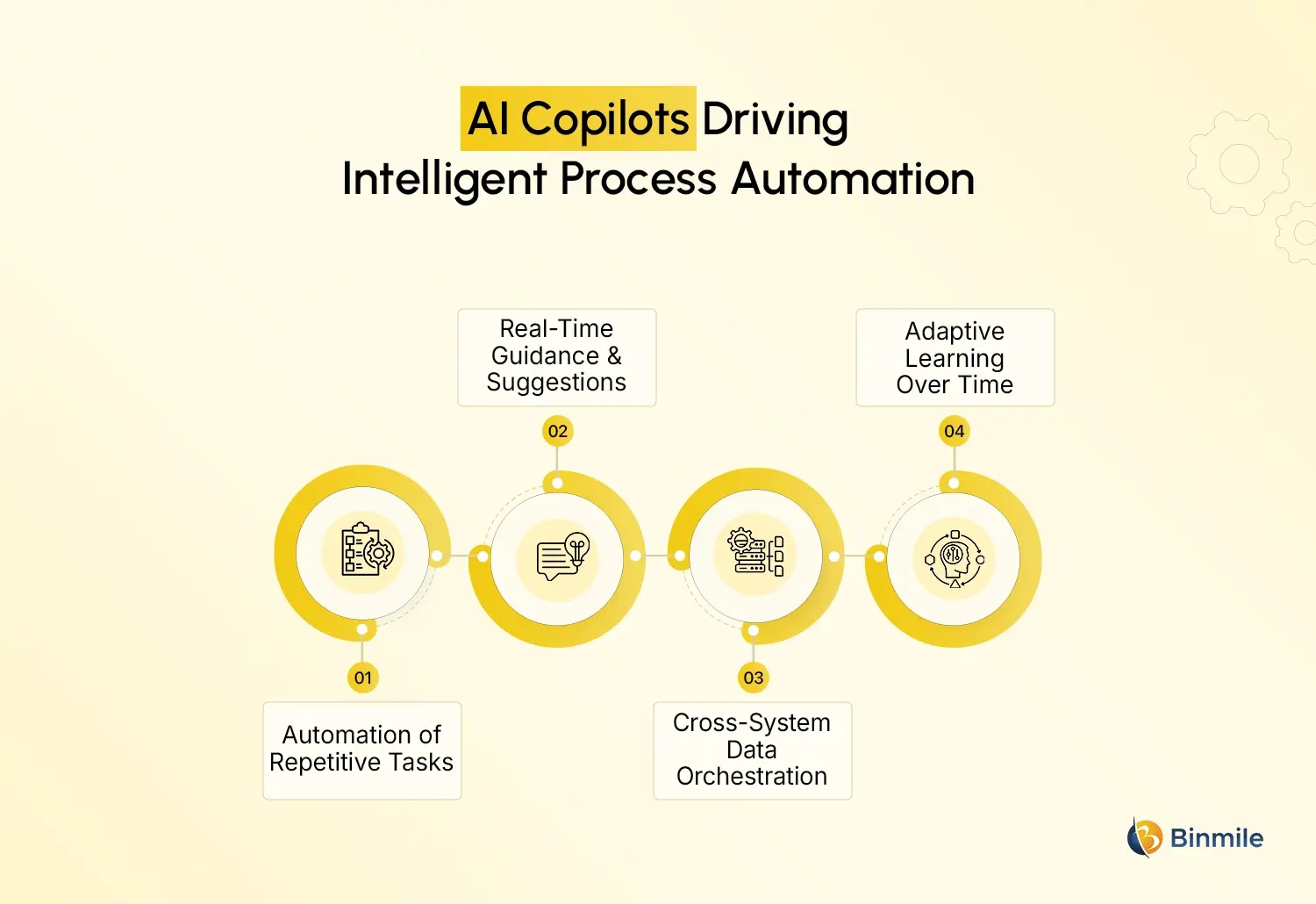
Understanding the automation capabilities of AI Copilots requires a look at how they fit into business operations. Here is how AI copilots can automate enterprise processes
-
Automation of Repetitive Tasks
Data entry, report writing, ticket filing, and document handling can be done by AI Copilots, which drastically reduces the need for manual efforts.
-
Real-time Guidance & Suggestions
Employees are given real-time recommendations based on the context of their current work, such as suggested actions, automated responses, and derived insights from enterprise data.
-
Cross-system Data Orchestration
There’s no need to search for data in multiple platforms because Copilots integrates data from different systems and shows it to the user in a single interface, thereby reducing the need for manual data retrieval and system switching.
-
Adaptive Learning Over Time
The user interactions with the Artificial Intelligence Copilot gradually improve the system’s understanding of the user’s preferences, workflow, and behavioral patterns, which enhances the system’s performance in terms of accuracy and relevance.
Looking to modernize your enterprise workflows with AI Copilots and intelligent automation?
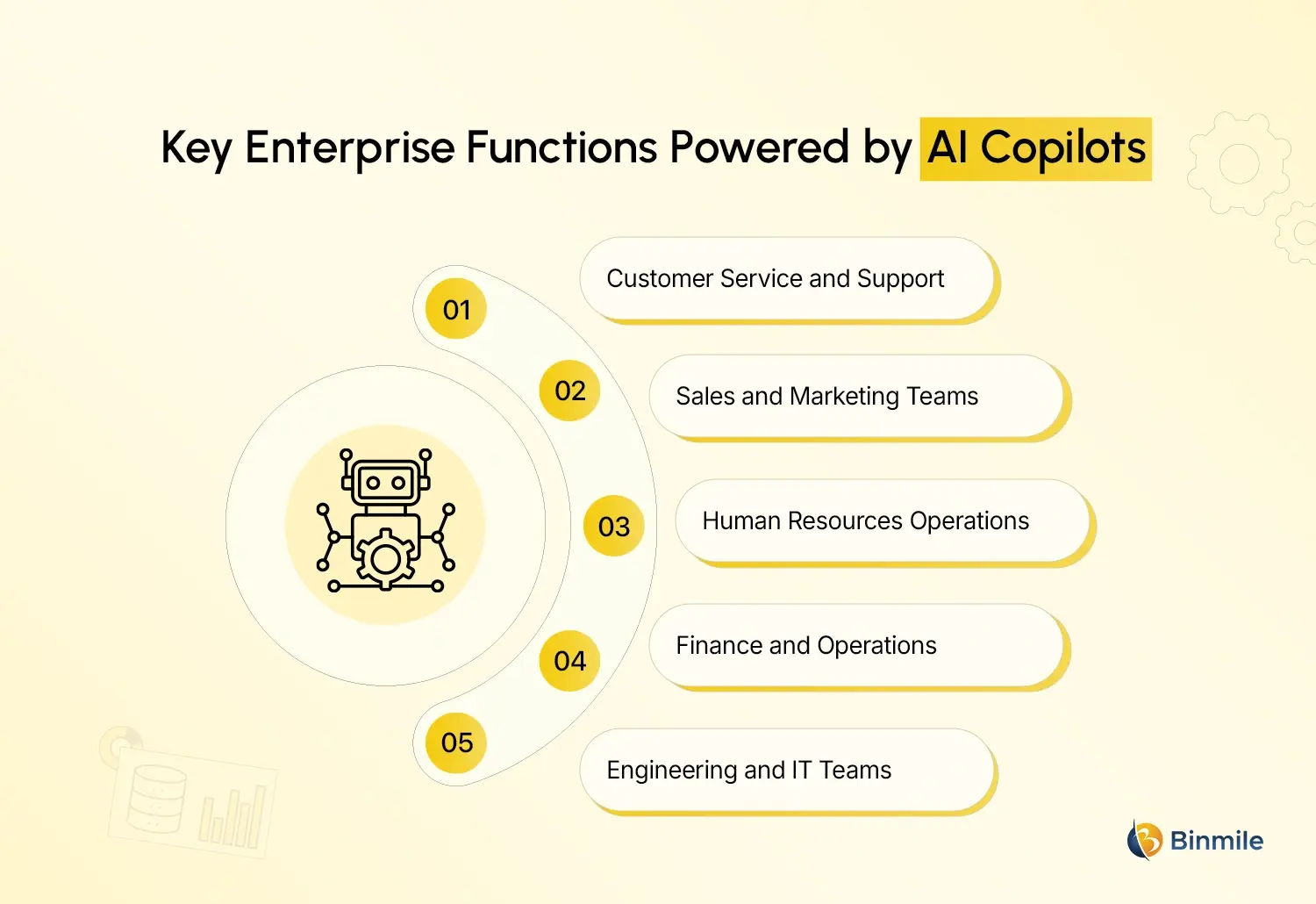
Which Business Functions Benefit Most from AI Copilots?
The impact of AI Copilots spans many business functions, but some areas benefit more immediately due to the nature of their work.
-
Customer Service and Support
Customer service and support teams can utilize AI Copilots right away due to the large amounts of repetitive interactions they face daily. AI Copilots make suggestions for responses, and AI customer service agents assist with ticket prioritization and can quickly retrieve articles from the knowledge base. For example, if a customer contacts support with a billing question, the AI Copilot can assist the support agent by pulling past invoices, payment history, and similar tickets that have been resolved. This helps the support agent respond to the customer quickly and accurately.
-
Sales and Marketing Teams
AI Copilots also help in sales and marketing by allowing teams to be in a proactive position rather than a reactive one. AI Copilots analyze customer behavior, browsing history, and past purchases to make personalized recommendations for outreach and marketing messaging. An example of this is a sales rep could ask the Copilot to identify the leads that have the highest chance of converting, and the system will provide suggestions for follow-up, as well as recommended actions based on the historical data.
-
Human Resources Operations
AI Copilots assist HR teams in the reduction of administrative tasks and help to improve the quality of hiring. Copilots help with tasks such as resume screening, scheduling interviews, answering policy questions, and onboarding processes. During the hiring process, for example, an AI Copilot can automatically schedule interviews and create a shortlist of candidates based on the position’s requirements. This saves a substantial amount of time, reducing manual coordination and speeding up the hiring process.
-
Finance and Operations
Teams in finance and operations gain improved accuracy and quickness thanks to AI Copilots managing data-intensive workflows. Invoice processing, account reconciliation, budget forecasting, and compliance checking become faster and more dependable. For instance, an AI Copilot can match invoices with purchase orders, and without any human involvement, it can report discrepancies and create financial summaries for the month.
-
Engineering and IT Teams
The productivity growth in engineering and IT functions is the result of AI Copilots assisting software development and providing operational support. AI Copilot guides aid in writing code, improving suggestions, precise bug locating, and test case creation. For example, an application developer can utilize Copilot to obtain real-time suggestions, and in the case of errors, Copilot will explain the error, thus reducing the overall AI Copilot development time and contributing to code quality.
How Do AI Copilots Improve Productivity and Efficiency?
People often think that the AI Copilot tools are all about replacing manual processes, and that the automation process simply takes one job away and replaces it with another. While there is an automation benefit, the more important and valuable part is the productivity and the efficiency it provides by using the employee’s potential.
To start, the use of AI Copilot tools saves time due to repetitive processes that employees often undertake. Once the routine processes, which may include things such as data entry and email writing, are completed, the employee is able to focus on other aspects like creativity, problem-solving, and other important managerial and strategic thinking roles. This should lead to an employee with higher job satisfaction and increased overall performance.
To continue, AI Copilots also improve the overall process. With manual processes, there is often human error, and processes and workflows often lead to undesired outcomes. When using the AI Copilot tools, processes are completed with more accuracy, and there is less rework that needs to be completed. This improves the overall process as well as the outcomes on customer service, compliance, and the overall experience of the customer.
AI Copilot tools also improve the overall productivity of the team because of the improved decision quality obtained with the use of supporting tools. Once more, the AI Copilots provide more than automation, as they offer more insightful suggestions. For example, an AI Copilot tool can review sales data trends and provide recommendations on how to alter customer service scripts.
Moreover, AI Copilots help businesses scale operations. As demand grows, these tools adapt without requiring proportional increases in headcount. This scalability is particularly valuable for organizations undergoing digital transformation strategies that depend on agile, efficient workflows.
Ready to accelerate operational efficiency and reduce manual workload with AI Copilots?
How Binmile Can Help Enterprises with AI Copilots
Integrating AI Copilots into enterprise systems requires expertise in both AI technology and business operations. That is where Binmile’s experience in enterprise AI solutions becomes valuable. With strong capabilities in custom software development services and cloud-based AI architectures, Binmile helps organizations design and deploy AI Copilot software that aligns with their specific needs.
From strategy to implementation, Binmile works on building AI Copilots on the cloud that integrate seamlessly with existing enterprise platforms like ERP, CRM, and workflow systems. Their team understands how to balance automation with user experience. This ensures that copilots act as trusted assistants rather than disruptive tools.
Frequently Asked Questions
AI Copilots are intelligent assistants that augment human workers by automating repetitive tasks, providing contextual insights, and speeding up workflows.
Enterprises adopt AI Copilots to reduce manual workloads, increase accuracy, speed up decision-making, and enhance overall operational efficiency.
AI Copilots replace manual workflows by automating routine processes, analyzing data across systems, and offering real-time suggestions that reduce human effort.
AI Copilots can automate tasks like customer query responses, data entry, report generation, scheduling, and code suggestions in development environments.
AI Copilots should be built by experienced enterprise AI development teams familiar with business systems, data integration, and scalable AI architectures.
The time to build an AI Copilot varies but typically ranges from a few weeks to several months, depending on complexity, data availability, and integration requirements.